A few bits of news gathered at and around the KGH event included that Twickenham Fine Ales brewer Stuart Medcalf (left) has revived the original recipe for Sundancer golden bitter. As a result it's back to the crisp, aromatic and lightly astringent beer that won a silver medal at the 2007 GBBF. Excellent! Twickenham is also now brewing a 'house beer' for Kew Gardens – this is on sale in the shops there and I'll try to get a bottle soon.
Also in bottle now are the soured beers that Twickenham's former brewmaster Tom Madeiros (now at Quercus in Devon, incidentally) brewed in collaboration with Belgium's Alvinne and De Struise breweries. These have been ageing in barrels for two years and have been bottled both straight and as a blend to smooth out the sourness and add depth.
With all its specials and six seasonal ales a year, Sharp's is now brewing a lot more than just Doom Bar, which has reportedly become the UK's no.1 cask ale. Formerly 95% of Sharp's volume, Doom Bar is now 85% - but of course overall production is up over 50% too, so that's still a lot more Doom Bar. The next best sellers for the brewers from Rock are Cornish Coaster, Sharp's Own and Sharp's Special. Oh, and there's a new American Pale Ale called Sharp's Atlantic due out in a couple of months.
While talking to David of Kew Brewery about his search for a brewkit, he mentioned that M&B has indeed sold the Botanist brewery, although not to him. Coming past the Botanist later on, I saw that the brewkit has now gone.
More to come...
Thursday, 24 April 2014
Kew's mini-beerex hits the spot
Went to a great Meet the Brewers session at the Kew Gardens Hotel last night – and yes, that's brewers in the plural. OK, not everyone presenting was an actual person-who-brews, but there were several of those present, including Dave from East London Brewery (ELB), Stuart from Twickenham, one of the Sambrooks brewers, and David who currently assists at Weird Beard but was there to showcase trial beers for his projected Kew Brewery.
Several other breweries were ably represented by their local sales folk, including Hogs Back, Meantime, Truman's, Sharp's and Greene King, the latter two showcasing their craft ranges, including GK's Belhaven beers. Some were pouring bottled beers, others had brought their draught beers in minicasks or flagons.
Some of the memorable beers included what I'm told was a barrel-aged version of Hogs Back's A over T (Aromas over Tongham) 9% barleywine, all winey and herbal-bitter with a raisiny sweetness, Sharp's Honey Spice IPA – more pale ale than IPA, albeit at 6.5%, but crisp with hints of orange and with the honey-spice subtly restrained, and Belhaven's 7% Scottish Oat Stout, dry-sweet with treacle, coffee and chocolate notes.
On top of all that, the KGH itself had an extra bar in the corner allowing it to offer a varied selection of well over a dozen cask ales plus several cask ciders – and this extra bar is staying around for a few more days. That's because the mini-beerex was the kick-off event for its beer and cider festival which runs until Sunday 27th, and promises 100 different ales over the five days, with three-thirds 'tasting bats' available as well as pints.
The KGH is just a short walk from Kew Gardens rail & tube station and is worth a visit – even more so while this festival is on. If you're in the area for beer, there is also Fuller's Tap on the Line by the station, and check out the Good Wine Shop in Kew village for an interesting selection of London-brewed and American/international bottled craft beers.
Several other breweries were ably represented by their local sales folk, including Hogs Back, Meantime, Truman's, Sharp's and Greene King, the latter two showcasing their craft ranges, including GK's Belhaven beers. Some were pouring bottled beers, others had brought their draught beers in minicasks or flagons.
Some of the memorable beers included what I'm told was a barrel-aged version of Hogs Back's A over T (Aromas over Tongham) 9% barleywine, all winey and herbal-bitter with a raisiny sweetness, Sharp's Honey Spice IPA – more pale ale than IPA, albeit at 6.5%, but crisp with hints of orange and with the honey-spice subtly restrained, and Belhaven's 7% Scottish Oat Stout, dry-sweet with treacle, coffee and chocolate notes.
On top of all that, the KGH itself had an extra bar in the corner allowing it to offer a varied selection of well over a dozen cask ales plus several cask ciders – and this extra bar is staying around for a few more days. That's because the mini-beerex was the kick-off event for its beer and cider festival which runs until Sunday 27th, and promises 100 different ales over the five days, with three-thirds 'tasting bats' available as well as pints.
The KGH is just a short walk from Kew Gardens rail & tube station and is worth a visit – even more so while this festival is on. If you're in the area for beer, there is also Fuller's Tap on the Line by the station, and check out the Good Wine Shop in Kew village for an interesting selection of London-brewed and American/international bottled craft beers.
Monday, 21 April 2014
Talking casks and kegs, with By The Horns
By The Horns was one of the first of the "new wave" of London breweries to commit itself to cask ale, while many of its approximate contemporaries took the (in many ways) cheaper and less complex path of kegging. So when the opportunity arose last week to visit the three-year-old brewery with a CAMRA group, I was eager to see how it has evolved, especially since it too is now kegging...
Clearly, the overall quality of its ale has not declined since its Diamond Geezer won beer of the festival at my local Twickenham Beer Festival in 2012, and the range has expanded. The most obvious change though is the brewery tap - when last I was there, probably two years ago now, founders Alex Bull and Chris Mills simply put some casks on gravity alongside the brewkit, plus some bottles and glasses on a table, and they opened to the public one Saturday a month, if that.
They have now moved all the fermenting vessels - and they are up to five of these - into a second industrial unit nearby. That has freed up space to put in a proper bar, done in the modern 'recycled wooden chic' style, along with four hand-pumps, half a dozen keg taps and a couple of small fridges. There's even a few tables and stools, a table-football game, and not one but two loos! The five-barrel brewkit is now behind Perspex, and they are open six days a week for off-sales (bottles), with the bar open Thursday-Saturday.
Head brewer Alex says that while some 85% of their business is still cask, there are many places that want to offer a locally-made craft beer but which only have keg lines. So they are also using 30-litre Keykegs and Ecofass kegs - the former are disposable while latter are reusable.
Both types are in effect a giant bag-inna-box, with the beer in a plastic bag inside the keg. Alex explains that although they are physically kegs, the beer is still pretty much 'real' - it is not carbonated or served under pressure; instead it is brewery-conditioned and primed as you would for bottling, and forced out by compressed air injected between keg and bag. "Beer definitely can condition - undergo a secondary fermentation - in a keg," he adds.
We were able to try half a dozen ales, in all three dispense forms. Stiff Upper Lip, a bitter golden ale, was on cask, as was a new release called Ol Blue Eyes CInaTRA - this is brewed with Citra hops as the name implies, and is in the modern pale ale vein, with tropical fruit notes to complement the citrus bitterness.
On keg, we tasted Bobby on the Wheat - I was a little reluctant as I'd not found this especially interesting in the past, but it turned out that while the name's the same, this is actually a new recipe. Now at 4% ABV, it's a dry-hopped wheat ale, sort of like a hopped-up Hefeweizen Leicht. It has a refreshing hoppiness and a lightly spicy body. Alex says he's pleased with the new version: "The extra carbonation lifts it a bit, and the dry hopping works better."
And from bottles we tried Gift of the Gab, Lambeth Walk, Mayor of Garratt and Hopslinger. The former is a coffee milk stout - Alex says it starts as just a milk stout, made with British Pioneer and First Gold hops, and is then aged on oak and freshly ground coffee for two weeks. As well as some chocolate malt, I spotted some roast barley in there too - the latter is what gives Guinness and some other stouts that burnt-bitter edge. The result is delicious, anyway!
Lambeth Walk is a rich caramelly beer with hints of cocoa and toffee. It's sold as a London Porter, which I'd tend to go along with, but one or two in our party felt it was closer to Old Ale in style. Hmm! Mayor of Garratt is a toffeeish and faintly nutty London-style bitter, and last but not least, Hopslinger is Alex's interpretation of an American IPA, with plenty of dry hoppy bitterness plus touches of toasted orange and tropical fruit.
All in all, it was a very enjoyable couple of hours and it provided a good catch-up, both on By The Horns specifically and on the state of craft ale in London more generally. Thanks again, Alex!
Clearly, the overall quality of its ale has not declined since its Diamond Geezer won beer of the festival at my local Twickenham Beer Festival in 2012, and the range has expanded. The most obvious change though is the brewery tap - when last I was there, probably two years ago now, founders Alex Bull and Chris Mills simply put some casks on gravity alongside the brewkit, plus some bottles and glasses on a table, and they opened to the public one Saturday a month, if that.
They have now moved all the fermenting vessels - and they are up to five of these - into a second industrial unit nearby. That has freed up space to put in a proper bar, done in the modern 'recycled wooden chic' style, along with four hand-pumps, half a dozen keg taps and a couple of small fridges. There's even a few tables and stools, a table-football game, and not one but two loos! The five-barrel brewkit is now behind Perspex, and they are open six days a week for off-sales (bottles), with the bar open Thursday-Saturday.
Head brewer Alex says that while some 85% of their business is still cask, there are many places that want to offer a locally-made craft beer but which only have keg lines. So they are also using 30-litre Keykegs and Ecofass kegs - the former are disposable while latter are reusable.
Both types are in effect a giant bag-inna-box, with the beer in a plastic bag inside the keg. Alex explains that although they are physically kegs, the beer is still pretty much 'real' - it is not carbonated or served under pressure; instead it is brewery-conditioned and primed as you would for bottling, and forced out by compressed air injected between keg and bag. "Beer definitely can condition - undergo a secondary fermentation - in a keg," he adds.
We were able to try half a dozen ales, in all three dispense forms. Stiff Upper Lip, a bitter golden ale, was on cask, as was a new release called Ol Blue Eyes CInaTRA - this is brewed with Citra hops as the name implies, and is in the modern pale ale vein, with tropical fruit notes to complement the citrus bitterness.
On keg, we tasted Bobby on the Wheat - I was a little reluctant as I'd not found this especially interesting in the past, but it turned out that while the name's the same, this is actually a new recipe. Now at 4% ABV, it's a dry-hopped wheat ale, sort of like a hopped-up Hefeweizen Leicht. It has a refreshing hoppiness and a lightly spicy body. Alex says he's pleased with the new version: "The extra carbonation lifts it a bit, and the dry hopping works better."
And from bottles we tried Gift of the Gab, Lambeth Walk, Mayor of Garratt and Hopslinger. The former is a coffee milk stout - Alex says it starts as just a milk stout, made with British Pioneer and First Gold hops, and is then aged on oak and freshly ground coffee for two weeks. As well as some chocolate malt, I spotted some roast barley in there too - the latter is what gives Guinness and some other stouts that burnt-bitter edge. The result is delicious, anyway!
Lambeth Walk is a rich caramelly beer with hints of cocoa and toffee. It's sold as a London Porter, which I'd tend to go along with, but one or two in our party felt it was closer to Old Ale in style. Hmm! Mayor of Garratt is a toffeeish and faintly nutty London-style bitter, and last but not least, Hopslinger is Alex's interpretation of an American IPA, with plenty of dry hoppy bitterness plus touches of toasted orange and tropical fruit.
All in all, it was a very enjoyable couple of hours and it provided a good catch-up, both on By The Horns specifically and on the state of craft ale in London more generally. Thanks again, Alex!
Wednesday, 16 April 2014
The return of the brewery hop-garden
Now this I like – brewery hop-gardens have been an increasingly common sight in the USA, but are rare in the UK. (Although Fuller's a few years ago dry-hopped a cask of Chiswick bitter with hops found growing wild on the brewery premises, and very nice it was too!)
That could be changing though: Hogs Back Brewery has just announced the planting of a 2½ acre traditional hop garden beside its brewery in Farnham, Surrey. It said this is "the start of a larger initiative to link Hogs Back with local raw materials and traditional farming skills," and will make it Britain's biggest brewer-hopgrower.
Hogs Back will plant over 2000 hop bines, a combination of the original Farnham White Bine and the newer Cascade variety. Farnham White Bine was the foundation of Farnham’s pre-eminence in hop growing in the 18th and 19th century, when it commanded the highest prices in the UK – at one time as much as 30% more than its Kent neighbours, the brewery said.
However, the last White Bine garden in the area was grubbed up in 1929, a victim of downy mildew and cheaper imported varieties. This new White Bine planting stock has been obtained from the National Hop Collection which is maintained by Wye Hops on behalf of the British Hop Association, and has been grown for Hogs Back by specialist grower Stephen Wright at Inghams Farm, Suffolk.
It helps that the soil at Hogs Back is ideal for hops, being a deep and high quality loam with a light alkaline chalk overlay. The site is gently sloping on the northern lee of the Hogs Back ridge and well exposed to sun with wind protection from traditional poplar planting. The Hogs Back brewing team will plant and grow the hops themselves, albeit with support from Bill and Bridget Biddell of Hampton Estates who grow all the brewery’s Fuggles hops, used in its flagship beer TEA. The Biddells are 4 miles away on the south of the Hogs Back ridge at Puttenham and will help with picking and drying.
Hogs Back said that both White Bine and Cascade will be used in beers that it will launch over the next 12 months, including contract beers for pubcos and a special beer featuring just these varieties. Hogs Back’s Hogstar New English Lager will also use some Cascade from the new hop-garden to replace one of the North American aroma hops currently used late in the boil.
“The Farnham White Bine was developed in the early 1700s by a Mr Peckham-Williams of Badshot Place, Farnham, which we can almost see from the brewery," said Hogs Back chairman Rupert Thompson. "It commanded a high price because of its delicate, distinctive aroma and the care taken in growing, picking and packing by the Farnham growers. Hops are influenced by the soil and micro-climate in which they are grown, and we are really excited to bring a local hop of such importance back to its roots, where it was first developed and from which Mr Golding selected his hops to produce the world renowned Goldings.
"It will be amazing almost 100 years later – as and when the hop bines are mature – to taste the flavours of such an important raw ingredient in our future beers. It will be wonderful to look out from the brewery and see the raw materials we use growing in the next door field – that’s local! That is part of what makes the craft brewing revival so exciting and we hope to build on this initiative with some further interesting innovations."
That could be changing though: Hogs Back Brewery has just announced the planting of a 2½ acre traditional hop garden beside its brewery in Farnham, Surrey. It said this is "the start of a larger initiative to link Hogs Back with local raw materials and traditional farming skills," and will make it Britain's biggest brewer-hopgrower.
![]() |
| Rupert Thompson & Bill Biddell toast the new hop-garden |
However, the last White Bine garden in the area was grubbed up in 1929, a victim of downy mildew and cheaper imported varieties. This new White Bine planting stock has been obtained from the National Hop Collection which is maintained by Wye Hops on behalf of the British Hop Association, and has been grown for Hogs Back by specialist grower Stephen Wright at Inghams Farm, Suffolk.
It helps that the soil at Hogs Back is ideal for hops, being a deep and high quality loam with a light alkaline chalk overlay. The site is gently sloping on the northern lee of the Hogs Back ridge and well exposed to sun with wind protection from traditional poplar planting. The Hogs Back brewing team will plant and grow the hops themselves, albeit with support from Bill and Bridget Biddell of Hampton Estates who grow all the brewery’s Fuggles hops, used in its flagship beer TEA. The Biddells are 4 miles away on the south of the Hogs Back ridge at Puttenham and will help with picking and drying.
Hogs Back said that both White Bine and Cascade will be used in beers that it will launch over the next 12 months, including contract beers for pubcos and a special beer featuring just these varieties. Hogs Back’s Hogstar New English Lager will also use some Cascade from the new hop-garden to replace one of the North American aroma hops currently used late in the boil.
“The Farnham White Bine was developed in the early 1700s by a Mr Peckham-Williams of Badshot Place, Farnham, which we can almost see from the brewery," said Hogs Back chairman Rupert Thompson. "It commanded a high price because of its delicate, distinctive aroma and the care taken in growing, picking and packing by the Farnham growers. Hops are influenced by the soil and micro-climate in which they are grown, and we are really excited to bring a local hop of such importance back to its roots, where it was first developed and from which Mr Golding selected his hops to produce the world renowned Goldings.
"It will be amazing almost 100 years later – as and when the hop bines are mature – to taste the flavours of such an important raw ingredient in our future beers. It will be wonderful to look out from the brewery and see the raw materials we use growing in the next door field – that’s local! That is part of what makes the craft brewing revival so exciting and we hope to build on this initiative with some further interesting innovations."
Thursday, 20 March 2014
Beer and there in East Twickenham
One of the fun things that local CAMRA branches do is to organise monthly pub-crawls, and my branch is no exception. Not only are they good social occasions, but they are a chance to visit areas and pubs that I don't often drink in – they also help the branch keep in touch with what's going on in that area.
Last night it was East Twickenham, an area which seems to have smartened up in recent years, yet where the trade has seen a bit of turmoil with pubs either lost to property developers or under threat – the two can be related of course. I missed the first pub on the list, the Aleksander freehouse (formerly a Young's pub called the Marble Hill), which was unfortunate as I'm told it was offering Oakham Citra and two Thornbridge ales.
Fortunately when I caught up with the other eight or so chaps in the Crown it was pretty much the highlight of the evening. Four ales on, all in excellent condition. A few years ago this was a pretty scruffy pub, but after it was refurbished and reopened last year it's now a delight – comfy, attractive, friendly service, and reputedly the food is good too.
From there it was a stiff trot to the Old Anchor. I don't think I'd been in here since it was a Youngs pub – it's been a freehouse for a couple of years now I think. It's also been under threat for longer than that, and now the end is near – for its current incarnation at least, which is probably why only two of its seven handpumps were in use, offering Ringwood Best and Jennings Lakeland Stunner. Barry the publican told us he's leaving at the end of April, and that plans have been submitted to turn almost the entire building into flats and also to build over the garden. The building's frontage is locally-listed however, so the developers say they will keep a tiny bar open there. I don't understand how they will get these plans through when they include no provision for parking, which is already in short supply.
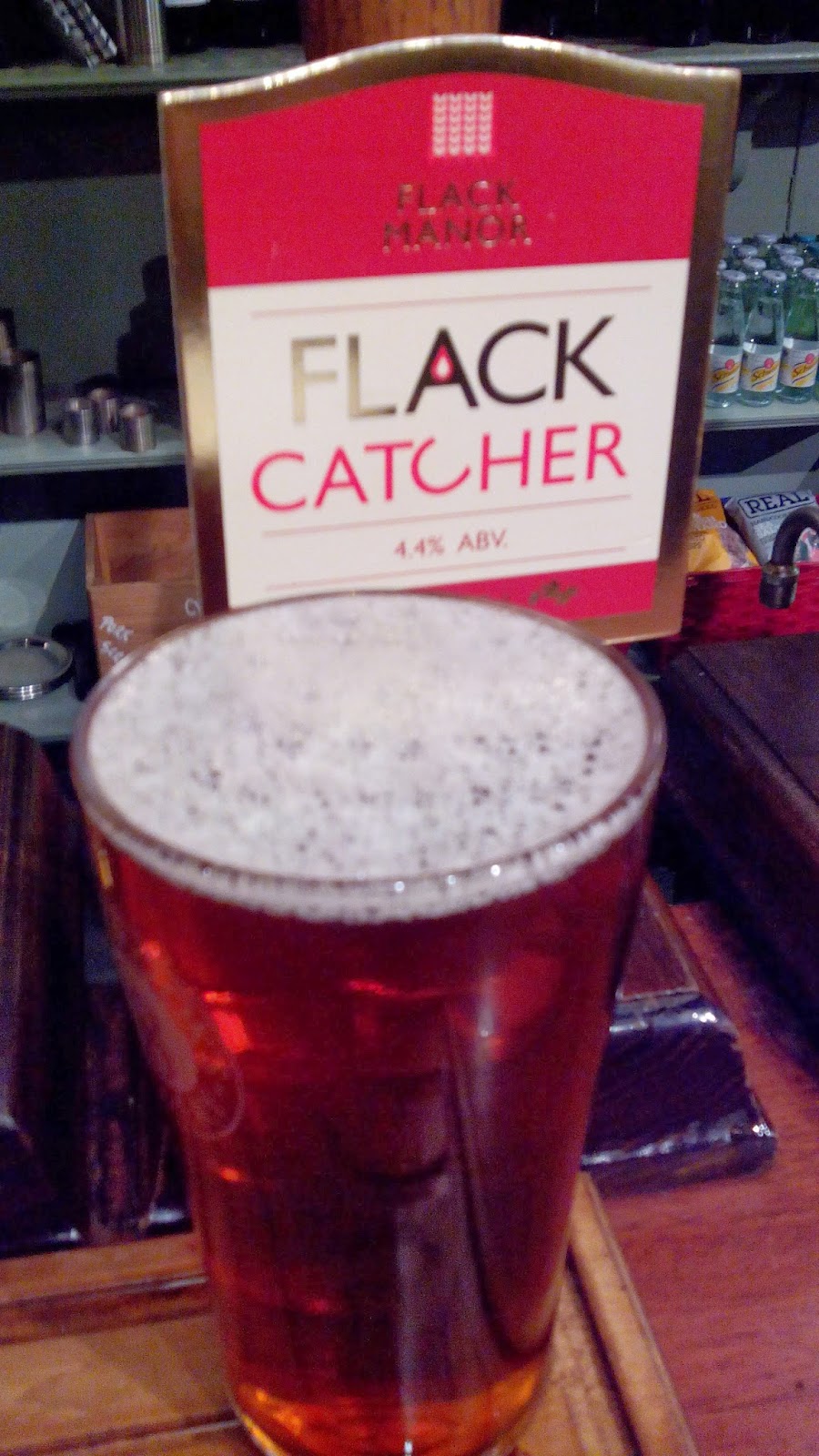
Then it was a stroll down to the Thames and the riverside White Swan. Another freehouse, the pub is raised up from the street and it looked like yesterday had been one of the days when the high tide floods both the road outside and the beer garden. Was this also why it reeked of fish, or was that left over from lunch? Either way, I think there were five ales on, all reportedly in fine condition, including my choice of Flack Catcher, a tasty bitter from a brewery I'd not heard of before, Flack Manor.
That was supposed to be the end of the crawl, but a few of us had been discussing the other changes in the area's pubs, in particular from the cr*ft beer perspective, so we decided to pay a quick visit to the relatively new Ales & Tails cocktail bar and 'craft beer house'. Although they advertise having eight cask ales, only two pump-clips were visible, one each from the Brighton and Hastings breweries, and both sadly tasted slightly sour. Fortunately, they had had just put on a third ale, Clarence & Fredericks' American Pale Ale, and that was excellent – but then I've not had a bad beer yet from this new Croydon-based brewery.
Last night it was East Twickenham, an area which seems to have smartened up in recent years, yet where the trade has seen a bit of turmoil with pubs either lost to property developers or under threat – the two can be related of course. I missed the first pub on the list, the Aleksander freehouse (formerly a Young's pub called the Marble Hill), which was unfortunate as I'm told it was offering Oakham Citra and two Thornbridge ales.
Fortunately when I caught up with the other eight or so chaps in the Crown it was pretty much the highlight of the evening. Four ales on, all in excellent condition. A few years ago this was a pretty scruffy pub, but after it was refurbished and reopened last year it's now a delight – comfy, attractive, friendly service, and reputedly the food is good too.
![]() |
| Two clips for the same beer! |
Then it was a stroll down to the Thames and the riverside White Swan. Another freehouse, the pub is raised up from the street and it looked like yesterday had been one of the days when the high tide floods both the road outside and the beer garden. Was this also why it reeked of fish, or was that left over from lunch? Either way, I think there were five ales on, all reportedly in fine condition, including my choice of Flack Catcher, a tasty bitter from a brewery I'd not heard of before, Flack Manor.
That was supposed to be the end of the crawl, but a few of us had been discussing the other changes in the area's pubs, in particular from the cr*ft beer perspective, so we decided to pay a quick visit to the relatively new Ales & Tails cocktail bar and 'craft beer house'. Although they advertise having eight cask ales, only two pump-clips were visible, one each from the Brighton and Hastings breweries, and both sadly tasted slightly sour. Fortunately, they had had just put on a third ale, Clarence & Fredericks' American Pale Ale, and that was excellent – but then I've not had a bad beer yet from this new Croydon-based brewery.
Friday, 14 March 2014
Drink London at London Drinker!
While it's often London's new keg and bottled beer breweries that get the limelight, cask ale microbreweries are on the up as well. So where just a few years ago you'd have been hard pressed to have a real ale festival with more than a dozen interesting London-brewed beers, this year's London Drinker Beer Festival claims that around 50% of its ales are from London.
Indeed, for the second year in a row the festival – which finishes today, so you still have time to get to it if I can get this online quickly – has a whole bar devoted to local beers, or LocAle, as CAMRA calls it.
I managed to try several yesterday, and also met several of the brewers – among them Clarkshaws, Clarence & Fredericks, Five Points, Late Knights and Twickenham – as we had all been invited along for a Trade & Press session during the afternoon break. (LDBF still has a 3-5pm break on its first two days, though not on the Friday – it gives the volunteers a bit of a break during what would otherwise be a very quiet time, plus it lets them do free admission for the lunchtime-only sessions.)
LDBF is 30 years old this year, and proudly bills itself as "the longest running beer festival in London in the same venue" – that's the old Camden Town Hall (now the Camden Centre) on Bidborough Street, opposite St Pancras station. It's a few years since I spent time there – it usually coincides with a big trade show in Germany where I had a regular work gig, so I've often been out of the country.
It's a great festival for trying a wide variety of cask beer. This year had plenty of volunteer staff so I never had to wait very long, and while there were a couple of beers that I didn't like, all those I tried were in good condition or better.
I know some people dislike how crowded LDBF can feel by early evening, but I recall from past years that if you take advantage of the seating in the balcony not only do you get elbow room and a place to sit, but you can also see that the crowds are actually a bit illusory. Sure, there's lots of people standing around, but somehow the shape of the big square main hall makes it look worse at floor level than it is, whereas from above you can see the free space as well.
Indeed, for the second year in a row the festival – which finishes today, so you still have time to get to it if I can get this online quickly – has a whole bar devoted to local beers, or LocAle, as CAMRA calls it.
I managed to try several yesterday, and also met several of the brewers – among them Clarkshaws, Clarence & Fredericks, Five Points, Late Knights and Twickenham – as we had all been invited along for a Trade & Press session during the afternoon break. (LDBF still has a 3-5pm break on its first two days, though not on the Friday – it gives the volunteers a bit of a break during what would otherwise be a very quiet time, plus it lets them do free admission for the lunchtime-only sessions.)
LDBF is 30 years old this year, and proudly bills itself as "the longest running beer festival in London in the same venue" – that's the old Camden Town Hall (now the Camden Centre) on Bidborough Street, opposite St Pancras station. It's a few years since I spent time there – it usually coincides with a big trade show in Germany where I had a regular work gig, so I've often been out of the country.
It's a great festival for trying a wide variety of cask beer. This year had plenty of volunteer staff so I never had to wait very long, and while there were a couple of beers that I didn't like, all those I tried were in good condition or better.
I know some people dislike how crowded LDBF can feel by early evening, but I recall from past years that if you take advantage of the seating in the balcony not only do you get elbow room and a place to sit, but you can also see that the crowds are actually a bit illusory. Sure, there's lots of people standing around, but somehow the shape of the big square main hall makes it look worse at floor level than it is, whereas from above you can see the free space as well.
Saturday, 1 March 2014
An evening of Clouded Minds and Viking Kings
I managed to indulge both my main interests last night - first, a talk at UCL on the impact of 1066 on Scandinavian royal hagiography[1], and then a walk around the corner to the Euston Tap.
The Tap was rammed when I got there, not too surprising I suppose given that it was just before 7pm on a Friday. So I got my first beer and after saying an unexpected hello to a CAMRA colleague who was already there with a mate, I left them to their chat and headed upstairs.
I stayed mainly on the cask ales, most of which seemed to fit one of two extremes – either porters and stouts, or London Murky in the New World Pale Ale mould. Which is to say, cloudy[2] golden ales with some underlying sweetness, tropical fruit notes, and lots of hoppy bitterness. All the cask ales were also flying off the bar – 50% of the time I requested a beer, it had run out before I managed to get any.
At the dark extreme, Moor's Sloe Walker – a version of Old Freddy Walker matured with sloes – was excellent. It was rich and complex, with a wonderful blend of flavours, including plummy (sloe), treacle, coffee and liquorice.
At the pale extreme, the stand-out ale was a 6.2% New World IPA from a brewery I'd never heard of, Clouded Minds. Called Dolce Vita, it's a cloudy dark gold, with tropical fruit and citrus aromas, touches of orange juice, a green-hoppy spiciness and a firm dry-bitterness. So I looked up the brewery and found its website – just a holding page for now, though – plus its rather more informative Twitter and Facebook pages, discovering in the process that it's a new London micro, which seems to have been brewing commercially for about six months.
People had been coming and going at my shared table all evening, so it was no surprise when a couple of guys took vacant seats and joined me. It was a surprise however when one of them invited me to taste the pint of black beer in his hand. It was an even bigger surprise when he introduced himself as Riccardo, the head brewer at Clouded Minds, and the beer as his Black Pike black IPA, which is rather tasty!
It turns out he's a former home-brewer turning pro, and that Clouded Minds is currently brewing on a one-barrel pilot plant based in Hornsey, North London. There's six beers in the current line-up and most of the production is cask-conditioned ale, though they also bottle the Dolce Vita and Black Pike. He's Italian, hence some of the names of their ales.
The size of the plant only gives them around 140 litres or four nine-gallon firkins per brew, so there is not a lot of their ale about. It seems to be doing very well though, and Riccardo said they will be moving to a larger industrial unit with a bigger brewkit later this year, "maybe by July." He also said a proper website should be up soon.
And while I did have an IPA last night that was better than Dolce Vita, that one was Ridiculously Close To Sanity, a 6.7% keg beer from Danish megastar brewers To Øl – not really a fair comparison! So all in all, Clouded Minds is definitely one to watch.
The Tap was rammed when I got there, not too surprising I suppose given that it was just before 7pm on a Friday. So I got my first beer and after saying an unexpected hello to a CAMRA colleague who was already there with a mate, I left them to their chat and headed upstairs.
![]() |
| Sloe Walker |
At the dark extreme, Moor's Sloe Walker – a version of Old Freddy Walker matured with sloes – was excellent. It was rich and complex, with a wonderful blend of flavours, including plummy (sloe), treacle, coffee and liquorice.
![]() |
| Dolce Vita |
People had been coming and going at my shared table all evening, so it was no surprise when a couple of guys took vacant seats and joined me. It was a surprise however when one of them invited me to taste the pint of black beer in his hand. It was an even bigger surprise when he introduced himself as Riccardo, the head brewer at Clouded Minds, and the beer as his Black Pike black IPA, which is rather tasty!
It turns out he's a former home-brewer turning pro, and that Clouded Minds is currently brewing on a one-barrel pilot plant based in Hornsey, North London. There's six beers in the current line-up and most of the production is cask-conditioned ale, though they also bottle the Dolce Vita and Black Pike. He's Italian, hence some of the names of their ales.
![]() |
| So's the Berlin Wall... |
And while I did have an IPA last night that was better than Dolce Vita, that one was Ridiculously Close To Sanity, a 6.7% keg beer from Danish megastar brewers To Øl – not really a fair comparison! So all in all, Clouded Minds is definitely one to watch.
[1] It's more interesting that it might sound! King Harald Hardrada was the golden boy: wise king, great Viking and battle winner, the man who escaped Constantinople despite the Byzantine Empress's desperate (nudge nudge) attempts to stop him.
By all the norms of early medieval king's-saga-writing, his trip to England in 1066 should have been a walk in the park, yet he got his dead arse handed to him on a plate by King Harold Godwinson. How on earth could this happen?!
The saga writers came up with all sorts of explanations: it was the pagan Norse fate goddesses the Norns, even though Hardrada was a devout Christian (like his sociopathic shit of a half-brother Olaf the Fat, called by some Saint Olaf); it was English sorcerors (boggle!); it was greed leading him to misinterpret his warning dreams; or it was the Trollish landvættir (land spirits) of England. Apparently Scandinavian writers were still trying 150 years later to come to terms with his defeat at Stamford Bridge (three weeks before King Harold was in turn defeated and killed by Duke William of Normandy).
In the Anglophone world we tend to think of 1066 from an English perspective – how it moved England from almost being part of Scandinavia to being part of a wider Western European (Frankish) world, but we have forgotten how the "loss" of England must have impacted the Scandinavian world and psyche. As I said, interesting stuff.
By all the norms of early medieval king's-saga-writing, his trip to England in 1066 should have been a walk in the park, yet he got his dead arse handed to him on a plate by King Harold Godwinson. How on earth could this happen?!
The saga writers came up with all sorts of explanations: it was the pagan Norse fate goddesses the Norns, even though Hardrada was a devout Christian (like his sociopathic shit of a half-brother Olaf the Fat, called by some Saint Olaf); it was English sorcerors (boggle!); it was greed leading him to misinterpret his warning dreams; or it was the Trollish landvættir (land spirits) of England. Apparently Scandinavian writers were still trying 150 years later to come to terms with his defeat at Stamford Bridge (three weeks before King Harold was in turn defeated and killed by Duke William of Normandy).
In the Anglophone world we tend to think of 1066 from an English perspective – how it moved England from almost being part of Scandinavia to being part of a wider Western European (Frankish) world, but we have forgotten how the "loss" of England must have impacted the Scandinavian world and psyche. As I said, interesting stuff.
[2] Satirised as London Murky, the current fashion for unfiltered beers doesn't worry me as such, not least because it's been going on in Germany for a decade or more, and it's kind of historical anyway. However, it's almost as if some London brewers are taking the piss by deliberately over-murkying things, which is just silly.
Subscribe to:
Posts (Atom)