Thursday, 13 December 2012

Is that craft beer - or merely crafty beer?

It's good to see a statement today from the US Brewers Association (BA) standing up for its definition of craft beer, and against deceptive practices by the big brewers such as setting up crafty sub-brands - even though the big brewers are BA members and are important to its funding.

In particular, the BA makes it clear that if a craft brewery - which it defines as one producing less than 6m barrels a year* - is more than 25% owned by a big brewer then it no longer qualifies as 'craft'. That means Goose Island is no longer officially 'craft', nor are Mendocino Brewing or Old Dominion, say. Imitation craft brands such as MillerCoors' Blue Moon are also excluded of course - there's a full non-craft list online here (PDF).

The statement goes on to say that the problem is not that the big brewers are trying to capitalise on the success of craft beer - hey, that's business - but that they are doing it covertly and unfairly.

The BA explains: "It's important to remember that if a large brewer has a controlling share of a smaller producing brewery, the brewer is, by definition, not craft.

"However, many non-standard, non-light 'crafty' beers found in the marketplace today are not labeled as products of large breweries. So when someone is drinking a Blue Moon Belgian Wheat Beer, they often believe that it's from a craft brewer, since there is no clear indication that it's made by SABMiller. The same goes for Shock Top, a brand that is 100 percent owned by Anheuser-Bush InBev, and several others that are owned by a multinational brewing and beverage company.

"The large, multinational brewers appear to be deliberately attempting to blur the lines between their crafty, craft-like beers and true craft beers from today's small and independent brewers. We call for transparency in brand ownership and for information to be clearly presented in a way that allows beer drinkers to make an informed choice about who brewed the beer they are drinking.

"And for those passionate beer lovers out there, we ask that you take the time to familiarize yourself with who is brewing the beer you are drinking. Is it a product of a small and independent brewer? Or is it from a crafty large brewer, seeking to capitalize on the mounting success of small and independent craft brewers?"

Strong stuff, eh?

*This is a very US-centric definition, as I noted in an earlier post here!

Friday, 7 December 2012

Cold and fizzy: how to kill craft beer in one easy lesson

Reading about fellow beer blogger Ed's visit to the Meantime Old Brewery in Greenwich, I was first amused and then saddened to learn that “the keg stout was cold, thin and fizzy.

He added: “What do people see in craft keg? I suspect to do it right you need to make a totally over the top imbalanced beer and then knock enough flavour out of it by kegging to make it drinkable.”

It amused me because I suspect this is what happens if you get people who are used to handling mega-brew chilled crud and ask them to look after craft keg. All the marketing, and all the drinkers who know no better, tell them if it's keg it's meant to be cold and fizzy.

And it saddened me because it's almost exactly my experience of American craft beer about 10 years ago, and I hoped we'd learnt something in the meantime. Back then I was being served beer that was too cold and too fizzy, presumably so it wouldn't frighten off the average American drinker. I learnt that the trick was to stir some of the gas out and let it come up a few degrees to release the flavour. It needed patience though, and it should not have been necessary.

Part of the problem seemed to be a kind of vicious circle – it was as if the craft brewers were making their beers really punchy so they'd stand a chance of surviving the chilling and fizzing, so the bars chilled them ever harder to keep a lid on that scary flavour – scary to anyone used to Lite Lager, anyhow.

(To make it worse, the US was just then getting interested in cask ale, and some brewers simply tried casking their existing beers and serving at 10-12C. I remember a pint in Denver that was barely drinkable – powerful flavours that worked well in keg at 5-6C, say, were not at all pleasant when served “warm and flat” by US standards.)

I really really want the world-wide craft beer revolution to work, but for that to happen the trade needs to understand that this isn't the easy-care keg crud that had CAMRA up in arms in the 70s, and which the big lager brands are still punting out. Just like real ale, craft keg needs care – perhaps not quite as much, but it still has to be at the right temperature and in good condition.

Have you had a crap pint of craft beer lately? If you have, what do you think was wrong with it – and did it leave you willing to have another try?

Sunday, 25 November 2012

What does Winter Beer mean to you?

Winter and Weihnachtsbiers, part two: When you think of Christmas and beer, what comes to mind – something rich and dark, or something golden and perhaps even a bit flowery?
When last I looked at German Weihnachtbiers and Winterbocks, they were definitely in the former camp, but to my surprise there are other brewers who fall into the latter. One such is Kulmbacher Mönchshof, which is part of the German Brau Holding International group. Its standard beers – Pils, Bayerisch Hell – are well-made but fairly typical; where it redeems itself for me is with its excellent Kellerbier, an amber-coloured brew resembling a lagered bitter ale.
So when I found Mönchshof Weihnachts Bier, I didn't expect it it would turn out to be a golden Märzen, especially when there's already a Mönchshof Festbier to fill that slot. Sure, as Märzens go it is rather nice – lightly hoppy and peachy, with some underlying spice notes – but it doesn't say Weihnacht to me...
Mönchshof is not alone in this. Carlsberg is touting the bizarre concept of a Tuborg Weihnachts Pilsener (I'd like to try a bottle, having seen from Ratebeer that it's not a Pilsener but a Vienna, but so far I've only seen it on sale in six-packs) and then there's Oettinger's Winterbier, which is very nice with pleasing green hop and toffee-nutty notes, but is more of an amber lager – perhaps even another Festbier, given its 5.6% strength.
Incidentally, quite a few people are snarky about Oettinger because it sells its beer so cheaply – typically €0.50 (40p) for a half-litre – and operates big industrial breweries, all of which has made it the largest beer producer in Germany. On the other hand, it is still locally owned and operates a very efficient single-tier business – it is famous for not advertising and for cutting out the distribution channel.
Anyway, it has not one but two seasonals, the other being a Bock. Weighing in at 6.7%, Oettinger Bock is dark amber with a malty and slightly raisiny nose, and a nice balance of grainy sweetness, bitterness and roasty malt. Yup, that'll do nicely for a cold winter evening. 
Also nice stuff, though at twice the price, is Altenmünster Winterbier Dunkel. Packaged in Altenmünster's trademark decoratively-moulded 500ml flip-top bottles, it balances the typical toffee-ish Dunkel flavours with the spicy hoppy bitterness that's familiar from the various (and somewhat samey) Altenmünster blonds.
And in any case, Oettinger beer is cheap but not the cheapest. The discount supermarket chains all sell six-packs of beer in plastic screw-top 500ml bottles, often priced at just €1.50 a pack, or 50 cents a litre. It's so cheap that the 25 cent deposit per plastic bottle doubles the cost of your purchase...

By the by, the German word that these shops use a lot is "billig", which seems to have more of a sense of "inexpensive" than "cheap". And while no-one wants to be thought of as cheap, everyone loves a bargain. That means everyone shops at Aldi, Lidl, Penny and the others, albeit sometimes in addition to one of the more up-market chains.

Anyway (again), usually it's just the normal boring German choice of Pils or Weizen, but our local Penny Markt now also has Adelskronen Winterbier, at €1.99 for six plastic bottles. This is a winter Dunkel brewed specially for Penny by Fankfurter Brauhaus – that's Frankfurt an der Oder by the way, right on the (modern) Polish border, not the better known financial centre down south – and it is rather good. It's a proper roasty Dunkel, with nutty plummy hints and a dryish body.

Both are certainly better than Carlsberg's other seasonal attempt, which is Holsten Stark. The best thing about this 7% Dunkel Doppelbock is the cool can design, which takes the usual Holsten horseman logo and recasts it in black, silver and gunmetal-grey. The dominant flavour is burnt sugar, there's a bit of roastiness, and the alcohol cuts the sweetness a bit, but overall it is not terribly good.

Last but not least, and showing that the multinationals – in this case AB-Inbev – can produce something decent, is Hasseröder Fürstenbräu Granat, or Princely-brew Garnet. Claimed to be in the style of an 1899 Royal Festbier, which means it'd be based on an amber Vienna lager, rather than the Johnny-come-lately golden Pilsner-alike versions, it's roasty and quaffable, with hints of toast and marmalade.

I'm sure there more: I'll keep looking, and drinking! In the meantime, what's the best winter beer – German or otherwise – that you've had so far this season?


Friday, 16 November 2012

Glühbier? Eek!

"Biermix mit Holunder" - that's beer flavoured with elderberries, justified by claiming it's for mulling. I'm afraid I didn't buy this...


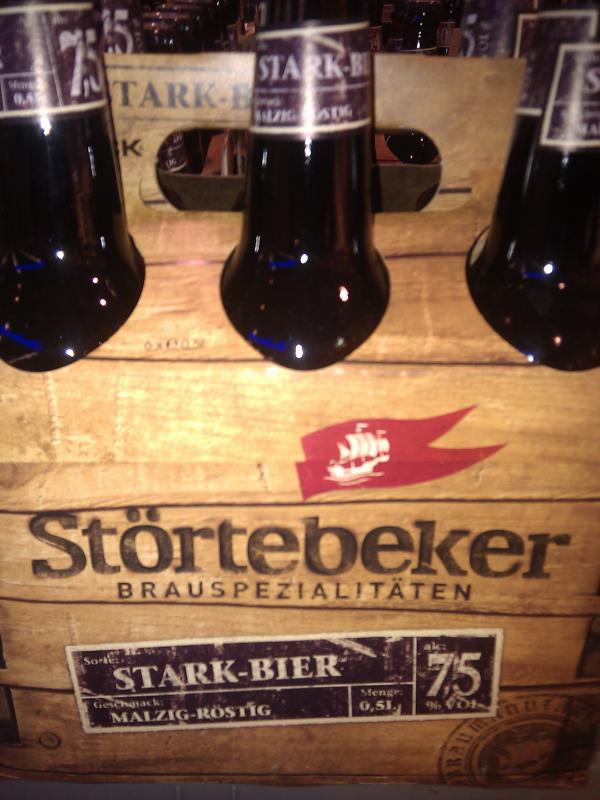
This, on the other hand, I did buy. From the same brewery, it is a German Baltic Stout - Stark and Stout in this context meaning the same thing, ie. "Strong".

I've been looking for this again since finding a four-pack in a random Getränkemarkt one snowy day about two years ago, and discovering that it was 7.5% of roasty dark-brown beery loveliness. I'm looking forward to cracking one (or two!) open later tonight.


Saturday, 3 November 2012

Winter beer, winter cheer

It's that time of year when North German beer gets a flavoursome and chewy boost – yes, as the nights draw in and the mercury plummets, we get ready for warming Winterbocks and Weihnachtsbiers. Of course there are other tasty Bocks produced year-round, but these malty, brown, and often roasty, nutty and/or spicy brews are much more seasonal in character – think of them as a dark step on from the lighter Märzens of autumn.
I didn't think to save a Flensburger bottle...
First to reach the shops this year – around here, at least – were two breweries from right up north , towards the Danish border: Dithmarscher and Flensburger. Both of them produce excellent Dunkels so I was looking forward to their Winterbocks. 
Both of them class as Doppelbocks, weighing in at 6.8% and 7% respectively. Dithmarscher's Urbock (=original bock) is chestnut brown with a little malt and a faint tang of orange on the nose. A little sweet at first, you then find hints of orange and apricot and it finishes with typically German herby-peppery hops and some burnt caramel. The burnt caramel is a bit of a theme with these beers. It's there in the 2012 edition of Flensburger Winterbock too, along with fruity malt aromas that feed through into a nutty body with a good alcohol bite, burnt caramel, and some peppery hops on the finish. 
I also briefly met a third example of the style at the Hamburger Craft Beer Day - Ricklinger Weihnachtsbock. Rather darker, this dark 7%-er brought hints of treacle and roast malt, with peppery notes. 
The next ones I spotted on the shelves were not one but two examples from Einbecker – a 5.3% Weihnachtsbier and a 7.5% Winter-Bock. The well-crafted amber Weihnachtsbier appears to be new this year but is typical of that style, being fairly dry and toasty, with burnt-bitter notes and some grassy hops layered over something resembling a Vienna amber lager. This year's Winter-Bock is vinous and slightly syrupy sweet, but the sweetness is well balanced with notes of burnt raisins and barley, some dryish hops and a good alcohol bite. 
Turning from the oldest to the youngest, Hamburg's Astra brand – now owned by Carlsberg and used as the trendy face of Holsten – has a 5.9% winter beer just out called Arschkalt. This literally translates to Arse-cold, which I guess is a bit like British breweries calling their winter ales Brass Monkey or somesuch. 
The label is designed to look like it's been torn off and a new logo scratched in. Fortunately, the contents mostly live up to this arty conceit – the dark amber beer has a nice balance of hops and caramelly burnt biscuit, with toasted fruit just about detectable in the background. There's no great complexity there, but it's pretty quaffable. Just don't do what the marketing idiots suggest and drink it chilled, because then it merely tastes thin and burnt. 
As you may guess from the above, there is a fair degree of similarity in all these beers, as if the brewers have been given a style guide and told to stick with it. I guess that means at least you know roughly what to expect when buying – and fortunately there is still a little room for individualism. 
The best of the bunch? For me it's the Einbecker Winter-Bock, though the Flensburger runs it close. Incidentally, Einbeck (which is not far from Hannover) is regarded as the origin of Bock. According to legend, its strong dark ale became especially popular in medieval times at the royal court down south in Munich, where the local accent turned its name into first Ein Bock (=a billy goat) and then just Bock. The Bavarian brewers then copied the style and shifted it over to bottom fermentation; even the northern examples are now bottom fermented lagers rather than top fermented ales.

Thursday, 1 November 2012

Shine on you Diamond Geezer

The results are in, and the Beer of the Festival for the 2012 Twickenham Beer Festival is a nearly local brew: Diamond Geezer, from Wimbledon-based microbrewery By The Horns.

I'm really pleased, because it's a lovely beer - a full bodied, fruity and malty 4.9% red ale. I've had it before in bottle, and it was excellent on draught at the festival so I recommended it quite a bit to visitors who were unsure what to try next.

As it happens, the brewery's managing director Chris Mills dropped into the festival on the Thursday evening. It took me a few moments, but I recognised him from meeting at the brewery at a couple of their excellent monthly Saturday afternoon Open Brewery events earlier this year. We had a bit of a chat and I complimented the Geezer; sadly though he has no immediate plans to repeat the 6.4% 'double' version, Diamond Geezers, which I thought was even better.

I don't know if I'll be in London in time for the presentation at the brewery, but I hope so!

Friday, 19 October 2012

Back on the ale...

Last Friday I had my first real ale in two months, this week I am having a bit more of it, as I'm at the Twickenham Beer Festival. If you've never been deprived of something like this, you don't realise what you've got or how lucky you are!

Anyway, we're open today and tomorrow until 10:30pm, and we have a great beer list and a great team of volunteers, so if you're in the area do please come over. One caveat is we don't have a foreign & bottled beer bar this year due to the council limiting the number of people we can have in the hall - sorry about that.

There's some lovely dark beers on the list - last year's festival champion Hammerpot Bottle Wreck Porter is back an in superb form, I also liked the Binghams Doodle Stout - and some lovely bitters and golden ales.

There's a few that are new to me, such as Windsor & Eton Canberra, which is on my list for this afternoon, Southport's tasty Cyclone, the Botanist's spicy Pumpkin Ale, which is a different version from last year and has been selling really well, three ales from new micro XT, and Mauldon's Octoberfest, which is a remarkable blend of a classic Märzen and a real ale. And of course some old favourites - Purple Moose Snowdonia, W&E Conqueror, Dark Star Hophead and more.