Showing posts with label Märzen. Show all posts

Monday, 27 July 2020

Monday in the land of breweries

Merkendorfer Kellerbier
One of the disconcerting things about travelling in Franconia, aka Oberfranken, is realising just how many of the place names I instantly recognise without ever having been to the vast majority of them. It comes from seeing them in the listings at Untappd, of course – and becoming familiar with all the many ways that visitors can misunderstand them...

A common one is that beers often have the name of their home town as a prefix, and foreigners assume that’s the brewery name. Or they mix up breweries of the same name but located in different towns. Scheßlitz? That’ll be Drei Kronen – the one I’ve not been to, but which often gets confused with the one I have, which is Drei Kronen Memmelsdorf. Drosendorf? That’s one of the two Brauerei Göller, And Schammelsdorf is of course Brauerei Knoblach. I think we saw all of those names on our way out on Monday morning, and we weren’t on the way to any of them!

Paradiestal
Instead we were after one of the other things Oberfranken has in spades, which is lovely countryside. Paradiestal, or Paradise Valley, is a popular hiking trail just off the A70 autobahn between Bamberg and Kulmbach – confusingly, it also has an autobahn Parkplatz (a motorway rest area) named after it, but this is not the start of the hike. That instead lies in fields and is rather awkward for the visitor to locate, unless of course you are sufficiently non-German to be willing to drive through fields along tracks marked “Farm traffic only”, or are local enough to know that the real route is to go the other way off the autobahn then backtrack through the village of Stadelhofen. But I digress, as indeed did our route.

"The Watcher"
Anyway, once you make it, finally locate the trail map and head off across the fields and into the woods, you are rewarded first by green valleys alive with flowers and butterflies, and then by the fantastical rock shapes for which the trail is reknowned. Carved out of the limestone by wind and water, they stand sentinel around the valleys, or lure the visitor up to explore lofty pinnacles or spooky caves.

Although we kept to the shorter 7km loop rather than the full 11km, we were still tired as we headed back to our start point. Fewer weird rocks, but still plenty of nature between the wheat and maize fields, and along the line of ancient apple trees. Finding a place for lunch had been a bit of a challenge – it’s still fairly common for places to take Mondays off (“Montag Ruhetag”) and the Corona crisis has made it worse. Some bierkellers and biergardens currently only open from Wednesday and some only do Friday-Sunday.

Fortunately I’d spotted a name I know well – Merkendorf – and found that one of the town’s two breweries, Brauerei Hummel, was open for beer and food. (The other, Wagner Merkendorf – one of at least four Wagner Bräu’s in the area, hence the need for the town name as a qualifier – takes Mondays off.)

Unlike last night’s dinner venue, the Löwenbräu Keller in Buttenheim, this wasn’t a verdant Bierkeller. It was the brewery yard, laid out with tables and benches – and with the usual-for-Corona one-way system and 1.5m-apart queuing lines taped out on the floor. (Table staff are all masked everywhere here, and guests must wear face-covers while moving around or queuing, but can take them off once seated.)

But it had a bit of greenery around, including a large shady tree, a play area which the kids loved, and the food and beer were hearty and – with one exception – excellent. I had the pork belly, roasty, salty, chewy and delicious, accompanied first by a classic hoppy-bitter and faintly toasty Kellerbier and then by Räucherla, their lovely smoky Rauch-Märzen. My one disappointment was ending with their Cowboy Schwarzbier – so sweet and gassy that I couldn’t finish it. Still, the brewery ‘shop’ was open, they’d sold out of the Rauchfestbier but we have Pils, Märzen and Festbier-Hell to try later – I’m sure they will make up for it!

Wednesday, 25 January 2017

A tale of Owls, Pussycats, Dodos and micropubs

The micropub revolution has reached West London – Ealing, to be precise, where in a week's time the population should have jumped from zero to two. The first one officially opened last Friday: called The Owl and The Pussycat*, it’s not too far from Northfields tube station, and even better, it has its own brewery.

If you’ve not been to a micropub before, they’re a relatively new phenomenon that was first recognised just over a decade ago, yet they embody ideals that are many centuries older. Typically, it’s a single room – often a former shop – converted into a small pub. The Micropub Association definition adds that it “listens to its customers, mainly serves cask ales, promotes conversation, shuns all forms of electronic entertainment and dabbles in traditional pub snacks.”

Mark, Roger Protz and Paul at the opening
The Owl and The Pussycat fits that to a tee. It’s the brainchild of two ex-teachers, Mark Yarnell and Paul Nock, and it took them almost a year to get it off the ground, what with finding premises and a brewing kit, and persuading the local authority to give them planning permission.

“I was teaching for 24 years, people said we were crazy, but a year later here we are,” says Paul. Fortunately the local support has been tremendous – as the letter-writing campaign that backed their planning application shows, locals have been fascinated by the project. Indeed, when the pair opened briefly before Christmas to test the waters, they were almost drunk dry and had to bring in emergency supplies from a friendly microbrewery.

In the long run they aim to be self-sufficient in beer though, thanks to having their own nanobrewery in the back room, working under the name Marko Paulo. Their UK-made 200-litre brewkit** took London’s tally of breweries to 92, and it allows them to fill five nine-gallon firkins (casks) per brew. Alternatively, they have 40-litre kegs for beers better suited to gas dispense – on my visit that meant an authentic German-style Oktoberfest-Märzen and a West Coast-inspired IPA.

The Marko Paulo Brewery
Rather unusually, they also have smaller casks: 4.5-gallon pins. Mark explains that the use of pins allows them to offer a wider range of beers – they have six handpumps and two keg taps, which could easily be a recipe for tired beer if it took too long for a cask to sell out. “Using pins keeps the beer fresh and let’s us keep variety on,” he says.

“We are brewing twice a week, and are pretty much at capacity now,” adds Paul. They’re limited not just by only having two fermenters – each brew takes about a week to ferment – but by how many filled casks and kegs they can fit in their cold-store.

The plan is to have two core beers, most probably their excellent Coal Porter and a best bitter, plus a rotating range of others. For example, at the opening event, which was kicked of by an entertaining talk on London’s brew history from Good Beer Guide editor and fellow*** beer-writer Roger Protz, we were treated to a mild, two pale ales (one of them ‘single hop and grain’ – I guess that makes for a more entertaining acronym than the more usual ‘single malt and single hop’!) and a hoppy bitter.

Mark says they hope to do collaboration brews with local home-brewers, and perhaps run a home-brew club. And they plan to run beer-and-cheese tastings/pairings with their next-door neighbours Cheddar Deli.

On top of all that, incredibly the local micropub population is about to double. One of the other guests at The Owl and The Pussycat’s official opening was Lucy, who is due to open her own micropub this coming Saturday. It’s called The Dodo and is in Hanwell, just up the road from Northfields. She’s not planning to brew, instead pouring a wide range of mainly London-brewed beers.


*The name comes from the bookshop that formerly occupied the site.
**made by Elite of Swindon, I noticed. 
***he’s been at it a lot longer than me, mind, and a lot more successfully too!

Friday, 1 August 2014

A hoppy weekend in Lower Saxony


We're in Germany on holiday, and last week I spotted an article in the local free newspaper* mentioning that nearby microbrewery Sommerbecker Dachs was having a family-friendly** summer festival for its fifth birthday. So on Saturday afternoon we headed out of town to the tiny village of Sommerbeck.

When the boy and I walked in, 30 minutes after the nominal 3pm opening time, we could only see two other visitors and the staff were still setting up the tills. He jumped onto the (free) bouncy-castle and I went for a beer.... I hadn't tried the Dachs Pils before – it proved to be a Landbier Pils in the northern style, so slightly hazy with a yeasty note, and with lots of bitterness but very little actual hop flavour. Not really my thing, in other words.

Once the girls arrived and we got a table, things picked up. The boy got his face painted (also free) and played on the slackline/tightropey thing, the baby was passed around and much admired, we were assumed to be local because, well, everyone else was, and my choices of beer improved. The Märzen was darker than the last time I tried it – more orange-brown than gold, with nutty and toffee notes and a touch of orange marmalade, while the Schwatt – their version of a Schwarzbier – was creamier and more Stouty than I remember.

Also interesting was the Hopfenstopfer – basically a hopped-up Helles or Pils that actually tastes and smells of hops, and in particular of hops other than the usual grassy German and Czech types. I think it translates as hop plunger or hop tamper, and to me it signifies that the brewer wants to do something a bit crafty, but doesn't want to "go foreign" with a Pale Ale or IPA. It was a nice example anyhow, with citrus and melon aromas and a spicy, tropical fruit accented body.

Also on tap, slightly unusually for the time of year, was the Dachs Bock. (Dachs – as in Dachshund – means badger, and the brewery mascot is indeed a stuffed badger.) Dark mahogany in colour, it had a malty nose with sultanas and cocoa notes, then a spicy-bitter body with touches of toffee, dried fruit and orange marmalade. Rather like a stronger version of the Märzen, and pretty tasty, hiding its 7.5% ABV well.

Then on Sunday we had planned a visit to Klindworths, easily the best brewpub I've found in northern Germany. Yet it's one that's not much known outside, in part because they don't sell their beer anywhere else – apart from a few beer festivals and parties where you might find their Beer Bus, an old VW camper converted into a mobile two-tap bar.

Things nearly went awry when the rest of the tribe announced that they wanted to go swimming first, but fortunately I remembered there's a Freibad, or open-air swimming pool, almost next door to the pub. So we were lightly sunned and watered by the time we sat down in the beer garden – and started batting away the flies while we waited for our dinner....

On tap were the Landbier Pils – a far better example of a flavoursome bitter lager than the Dachs one – plus the Weizen, the Keiler German brown bitter, the Pale Ale and the IPA. I went first for the Pale Ale, as I already knew it to be excellent and I thought going for the 6.7% IPA on an empty tummy might not be wise. It did not disappoint – refreshingly dry-bitter, with loads of hops and a malty body. Brewer Niko calls it his interpretation of British Pale Ale; I'd say it is as hoppy as an American Pale Ale, but fuller bodied than the average APA.

Then it was time for the IPA – the only one of his regular or seasonal beers that I'd not tried yet. It's a chunky and thoroughly moreish IPA in the American vein, full of hops and with a warming alcohol bite, yet malty enough to not be overpowering. Even at 6.7%, it's balanced enough to go back for seconds, which I duly did.

Thankfully I wasn't the one driving back – one of the challenges of Klindworths is that it is awkward to get to unless you're already in the area (there's a campsite by the Freibad, and the pub does B&B). There are buses from Buxtehude, but the service is not very frequent and it stops running quite early too. I'd have gone there a lot more often otherwise!


*These still report stuff and are widely read, unlike the UK equivalents which are almost all run now by bread-heads too stupid to realise that if they cut or de-skill all the running costs, ie. journalists, no one reads the result and they lose all the advertising revenue that they're so greedy for.

**One of the things I miss in Britain is that very few beer festivals seem genuinely family-friendly.

Thursday, 10 October 2013

Exactly what is exacting?

Nonsense like this - from brewpub chain Gordon Biersch, which I visited this afternoon in Broomfield - makes me go "Grrr!"

"Exacting standards"? All it does is specify the usable ingredients, very generally.

The beer was OK, but it reminded me too much of just how average the average German brewpub is.

Saturday, 24 August 2013

Around Bamberg #8: a sunny Sunday in the Bierwald

A Hebendanzly view...
A bit delayed, I know, but we're finally coming towards the end of the week... Annafest on Sunday afternoon was both more organised and more civilised. We started earlier – after lunch – and the place was generally less crowded. The combination of beer with warm sunshine and green shady trees was sublime.

We had the boy with us this time, so we explored the fairground on the way and were also delighted to find that, as well as Bierkellers and lots of food and snack stalls, the woods hold a number of children's playgrounds. We even found a wine-tasting bar, set up to raise money for the local volunteer fire brigade.

The event felt different today – less frenetic than Saturday night, unsurprisingly, and there was the sense of people settling into favourite places for a long and enjoyable afternoon's boozing. Apparently this is indeed what happens – most people find their preferred Keller and just stay there for hours, with none of this awkward moving around to find different beers...

Grief Festbier
So when we did move around, it wasn't that hard to find a free table. After starting in the Greif Keller, we moved across the way to Hebendanz which goes up into the woods in a series of terraces and had plenty of room on the upper decks. After a few excursions for food, ice cream and so on, we wandered back down the hill to the Kupfer Keller, which this year it had a special beer on. This was Brauwastl Festbier, created by three hobby-brewer friends from the town who then had their recipe commercially brewed by Neder.

So how were the beers? A bit samey, I thought. With the exception of the Brauwastl, all were malty quaffing lagers with a varying degrees of sweetness and not a lot of bitterness. Some had light spicy notes and a faint roastiness. I think I'm going to call them Kellermärzens, which is a term I just made up but which I reckon is a good fit.

They were also rather expensive – the standard price was €7.40 a litre, plus normally €5 deposit on your Maßkrug. This is in an area where a regular countryside Bierkeller might charge €3.50 or €4 a litre for its Kellerbier, albeit that will not be quite as strong (maybe 4.9% to 5.3% for a typical Kellerbier, versus 5% to 6% for the Festbiers). But these are festival prices, so I suppose we shouldn't be too surprised at them.

(By the by, I should quickly point out that it's not all Festbiers. Most Kellers also have a couple of bottled beers on offer, typically a Weisse and maybe a Dunkel. These you can buy in halves as well as litres – the latter just means they pour two bottles into one Maßkrug for you.)

The best of the five regular Festbiers was the Grief: fuller bodied than the others and with touches of toasted orange and a little more bitterness. Overall though, it was the Brauwastl. Perhaps it was the fact that it wasn't an easy-quaffing Kellermärzen that made it taste notably better, or perhaps it was that it was significantly darker than the others, verging towards a Schwarzbock or a stronger version of Neder's Schwarze Anna, and that I like dark beers.

Would I go again? Of course – though I'd probably try for midweek if feasible. I reckon Ron Pattinson's idea of going there on Monday was pretty good. And as well as a friend or two, I'd take a couple of smaller glasses to decant into, so litres could be shared....

Thursday, 18 July 2013

A week around Bamberg, part one

Day one

We arrived late on Sunday afternoon after a long journey made even longer and more tedious by crap roadworks on the A7. Fortunately there was still time for our friend Tom and I to take a short walk into the Altstadt. Starting at Schlenkerla with a Märzen might have been clichéd, but it worked nicely. The Rauch Weizen was pretty good too.

Walking back though, there were a couple of things we noticed. One was that even in Bamberg, that legendary city of beer, Pils has broken in big-time. Yes, the famous old brewpubs still do their famous Rauchbiers and Kellerbiers, but in the other bars the glasses of golden fizz were all around.

The second is how many former beerhouses have been turned into ethnic (Italian/Chinese/Mongolian/etc) restaurants. They may still offer local beer, perhaps due to long term supply contracts, but who wants to drink good beer with food smells around?

Luckily most still have their beer-gardens, so we stopped for a beer at one, Griessgarten, which is now mostly a Mexican restaurant indoors. The beer was OK, nothing special, so it was into Der Pelikan for a couple of decent-enough Helles – it has a broad beer range for a German pub, plus Thai food, but it is definitely still a pub-with-food, not a restaurant. So much for “just two or three beers, then an early night”...

Day two

Was a more relaxed day in town, shopping for all the stuff we'd forgotten to pack, like hats for me and the boy... It was sunny, the Grüner Markt was full of strawberries and cherries, the ice-cafés were open, and the old Rathaus looked lovely from just over the bridge, where we sat drinking Alt-Bamberg Zwickl.

Wandering around some more, we found Heska, a bar Tom that had seen before but it had been closed. It's been open again for nine months, apparently, and is a quite chic'ly furnished local with Weismainer beers on tap. Nice.

*We also discovered that our lodgings do not after all have Wi-Fi. Also, as far as I can tell there is no public Wi-Fi in town, free or paid-for. What is this, the Middle Ages?

It means precious few blog updates, anyhow, as all I have is a laggy 50kbit/s data connection via my phone. Sigh.

Saturday, 18 May 2013

Brauereifest, doubled!

One of the nice things about this part of the world is the attachment to festivals. Pretty much every community seems to have its village fair, summer festival or autumn fête, with its line-up of local voluntary groups, almost always including the volunteer fire brigade of course, plus entertainment for the children, maybe music for the adults, and stalls selling cakes, coffees, and bratwurst.

Enjoying the music at Klindworths
A more recent addition to the roster – as far as I can tell, anyhow – is the brauereifest, or brewery festival. It seems to be part of a rekindled interest in localism, local businesses and local produce. Even the big boys have got into the act, with Carlsberg-owned Holsten promoting its third annual brauereifest back in April under the slogan "Hamburg is Holsten and Holsten is Hamburg".


I couldn't get to the Holsten one, but last weekend we visited not one but two rather smaller brauereifests, the first at the Klindworths brewpub in the countryside southwest of Hamburg, and the other at the tiny village of Sommerbeck to the east of Lüneburg, where the Sommerbecker Dachs (Dachs=Badger) microbrewery is based.

Fun & games in Sommerbeck
The basic format for all three events was pretty much as you'd expect: a family fun-day, with live music, beer and food. It's not so much about the brewery itself, although tours are sometimes on offer, as it is about asserting its connection with the locality. For example, as the village pub for some 350 years, Klindworths invited all the locals to come and be photographed for a village project.

Both the brauereifests we went to were good fun, though they were noticeably different. Klindworths was very local, yet friendly to us non-locals. The afternoon music – pub-rock covers – was excellent and lively, the beer garden was roomy and sufficiently sunny, and Niko's beer was as excellent and characterful as ever. As well as the regular Landbier Pils, on tap were the frisky 2013 Maibock, with citrus and gingery hops, and the rich and slightly chocolatey brown Stout. I was tipped off too that if I went inside, the Weizenbock was on, which was delicious and Cascade hoppy (that's the brewer's hand you can see in the photo below, pouring the next one).

Tasty Weizenbock
They did a really great job of entertaining the kids too. Among other things, there was a superb balloon artist – Roric went back time and again, coming back first with not only a balloon sword but a balloon swordbelt for it, and then later with a complete balloon aeroplane and pilot – plus a pile of hay with sweeties hidden in it, and a raffle-type game.

Where Dachs scored was the variety of food stalls around. As well as the inevitable (and good) sausages, there was a specialist chips and fried potato (bratkartoffel) van, and a cake stall. The beers – their regular Pils and Marzen, plus an Oktoberfest called Okti, and Schwatt which is apparently dialect for schwartz – are very nice in a crafted mainstream way. The kids certainly appreciated the bouncy-castle and football games, at least until the rain started. Sommerbeck was also more crowded, even before the rain forced everyone undercover and made it worse. I think they had publicised it more widely – there certainly looked to be a good few Hamburg yuppies present.

With the summer fair season only just getting going now, we are looking forward more events of the kind!

Wednesday, 24 April 2013

In the merry merry Bock of Mai


It's spring – at last, after what seems like four months of snow and ice. That's not a lot to the Canadians and Scandinavians out there, but it is for northern Germany. Finally we can really enjoy the Maibocks that have been impatiently sitting on the shop shelves since mid-February. Yes, in Britain it's the easter eggs that arrive two or three months early, in Germany it's the seasonal beers....

A few Maibocks, left-right is roughly north-south
Maibock is a relatively recent addition to the German beer canon, although it is recognisably part of the wider Hellesbock (pale bock) family*, and is quite similar to Dutch Lentebock. Most of the Maibocks I see are Nordisch (Northern) ones – not too surprisingly, given that we're less than 100 miles from either the Baltic or the North Sea – but there are quite a few Bavarian Maibocks too. However, in the south they must compete with the tradition of Märzen, which historically was brewed up until April. For example. the Osterbiers (easter beers) I see from down south are mostly Märzens.

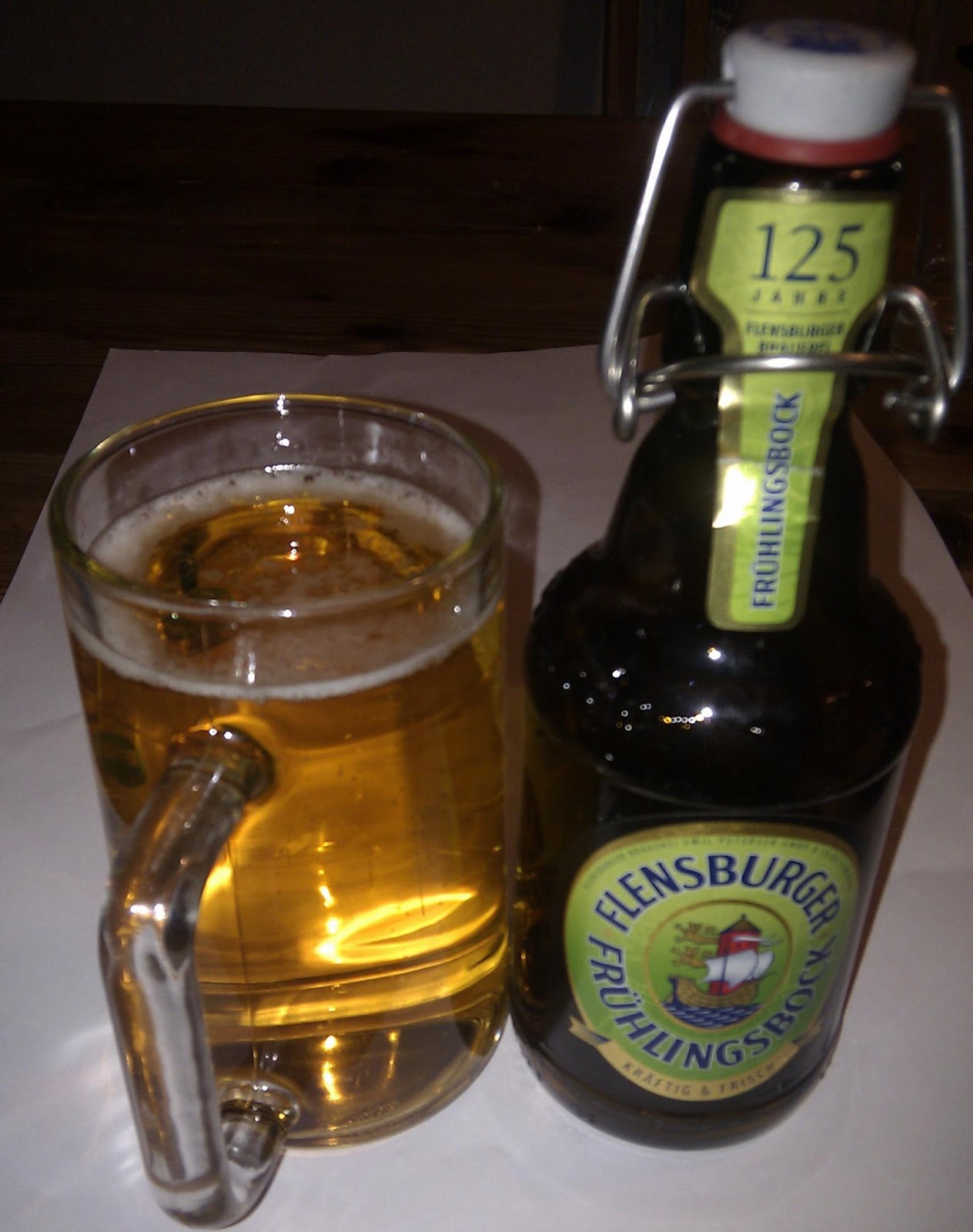
Also called Frühlingsbock (spring bock) by some, Maibocks are malty, but typically hopped up, drier and a little more bitter than other Hellesbocks. They range from amber to gold, and the hoppiness is often spicy, green, maybe lightly pine or citrus – and yes, it is intended to make you think of spring.

Certainly, the Einbecker, Dithmarscher and Flensburger examples are very much in this mould. There are exceptions of course – for instance, the Maibock from Vielanker, a microbrewery in Mecklenburg, just the other side of what was the Iron Curtain, is perhaps more like a Märzenbock, if such a thing is possible. (And if it's not, why not?!)

As I mentioned, look south and things change a little – the Maibocks are often maltier and, well, Bockier. Some claim this relates to a tradition that late April and May were the times when the first new Bocks of the year were tapped, though as with so many German "traditions" I'm not wholly convinced, especially since we have Doppelbocks and Winterbocks through January and February. It could well be that the fresh Bock of May is inevitably a hoppier beast than the aged Bocks of winter, I guess.

And no, I don't know why the northerners seen above are all 33cl stubbies while the southerners are 50cl long-necks. Nordisch quirkiness versus stolid Bayerish tradition, I suspect!

*Some people argue that Hellesbock (or Hellerbock) and Maibock are the same thing. I disagree – not least because Maibock is seasonal in availability, whereas the likes of Andechser Bergbock Hell are available year-round.

Sunday, 25 November 2012

What does Winter Beer mean to you?

Winter and Weihnachtsbiers, part two: When you think of Christmas and beer, what comes to mind – something rich and dark, or something golden and perhaps even a bit flowery?
When last I looked at German Weihnachtbiers and Winterbocks, they were definitely in the former camp, but to my surprise there are other brewers who fall into the latter. One such is Kulmbacher Mönchshof, which is part of the German Brau Holding International group. Its standard beers – Pils, Bayerisch Hell – are well-made but fairly typical; where it redeems itself for me is with its excellent Kellerbier, an amber-coloured brew resembling a lagered bitter ale.
So when I found Mönchshof Weihnachts Bier, I didn't expect it it would turn out to be a golden Märzen, especially when there's already a Mönchshof Festbier to fill that slot. Sure, as Märzens go it is rather nice – lightly hoppy and peachy, with some underlying spice notes – but it doesn't say Weihnacht to me...
Mönchshof is not alone in this. Carlsberg is touting the bizarre concept of a Tuborg Weihnachts Pilsener (I'd like to try a bottle, having seen from Ratebeer that it's not a Pilsener but a Vienna, but so far I've only seen it on sale in six-packs) and then there's Oettinger's Winterbier, which is very nice with pleasing green hop and toffee-nutty notes, but is more of an amber lager – perhaps even another Festbier, given its 5.6% strength.
Incidentally, quite a few people are snarky about Oettinger because it sells its beer so cheaply – typically €0.50 (40p) for a half-litre – and operates big industrial breweries, all of which has made it the largest beer producer in Germany. On the other hand, it is still locally owned and operates a very efficient single-tier business – it is famous for not advertising and for cutting out the distribution channel.
Anyway, it has not one but two seasonals, the other being a Bock. Weighing in at 6.7%, Oettinger Bock is dark amber with a malty and slightly raisiny nose, and a nice balance of grainy sweetness, bitterness and roasty malt. Yup, that'll do nicely for a cold winter evening. 
Also nice stuff, though at twice the price, is Altenmünster Winterbier Dunkel. Packaged in Altenmünster's trademark decoratively-moulded 500ml flip-top bottles, it balances the typical toffee-ish Dunkel flavours with the spicy hoppy bitterness that's familiar from the various (and somewhat samey) Altenmünster blonds.
And in any case, Oettinger beer is cheap but not the cheapest. The discount supermarket chains all sell six-packs of beer in plastic screw-top 500ml bottles, often priced at just €1.50 a pack, or 50 cents a litre. It's so cheap that the 25 cent deposit per plastic bottle doubles the cost of your purchase...

By the by, the German word that these shops use a lot is "billig", which seems to have more of a sense of "inexpensive" than "cheap". And while no-one wants to be thought of as cheap, everyone loves a bargain. That means everyone shops at Aldi, Lidl, Penny and the others, albeit sometimes in addition to one of the more up-market chains.

Anyway (again), usually it's just the normal boring German choice of Pils or Weizen, but our local Penny Markt now also has Adelskronen Winterbier, at €1.99 for six plastic bottles. This is a winter Dunkel brewed specially for Penny by Fankfurter Brauhaus – that's Frankfurt an der Oder by the way, right on the (modern) Polish border, not the better known financial centre down south – and it is rather good. It's a proper roasty Dunkel, with nutty plummy hints and a dryish body.

Both are certainly better than Carlsberg's other seasonal attempt, which is Holsten Stark. The best thing about this 7% Dunkel Doppelbock is the cool can design, which takes the usual Holsten horseman logo and recasts it in black, silver and gunmetal-grey. The dominant flavour is burnt sugar, there's a bit of roastiness, and the alcohol cuts the sweetness a bit, but overall it is not terribly good.

Last but not least, and showing that the multinationals – in this case AB-Inbev – can produce something decent, is Hasseröder Fürstenbräu Granat, or Princely-brew Garnet. Claimed to be in the style of an 1899 Royal Festbier, which means it'd be based on an amber Vienna lager, rather than the Johnny-come-lately golden Pilsner-alike versions, it's roasty and quaffable, with hints of toast and marmalade.

I'm sure there more: I'll keep looking, and drinking! In the meantime, what's the best winter beer – German or otherwise – that you've had so far this season?


Wednesday, 12 September 2012

Just cos it's in a tent, does it have to be camp?

pic by @bryan_gb
It's Oktoberfest season here in Germany – and yes, it is still September here too, it's called Oktoberfest because it ends in October. All over the country, what might once I suppose have been harvest festivals have become local imitations of the Munich original, complete with Bavarian beer, blue and white bunting, and of course silly hats.

Lüneburg's version is quite early, small and short – just four days, finishing yesterday (when the Munich one doesn't open until the 22nd), and only one giant beer tent. Presumably the tent will now be taken down and moved somewhere a bit bigger for another Oktoberfest next weekend.

It's not just the beer tent though – there's also assorted fun-fair stalls and children's fairground rides, places to buy various kinds of hot and cold food, and there are lots of other outdoor bars. Fittingly, most of the other beer on sale was northern, with Duckstein (now owned by Carlsberg, and I believe brewed at the Holsten site in Hamburg) the most prominent. Also around were Holsten and Lüneburger Pilsners (both also from Carlsberg/Hamburg), and AB-InBev's Diebels Alt, though by the look of it the latter was only available as an “Alt Bowle” which is a beer cocktail or punch, complete with chunks of fruit.

When we finally reached the big tent late on Sunday afternoon, a pair of entertainers were banging out versions of 60s/70s Country classics – Sweet Caroline, Country Road, that sort of thing – to a small but reasonably appreciative crowd. After they went off stage things got a little odd, when a rather fey chap who appeared to be a member of the audience took the mike and started singing. His voice was good, not great, but it was abundantly clear that he knew how to use a stage.

Anyway, we were about to finish our beers – Löwenbräu Oktoberfest, which was competent; the alternative was Franziskaner weiss, and both are now AB-InBev properties – and head home for something with a bit more depth of flavour, when I spotted that the menu also listed the weekend's entertainment, and Sunday night was a "Travestie Show", ie. a drag cabaret...

pic by @PsycheDK
I've seen some strange things at beer festivals, but this pretty much takes the biscuit. The highlights, if one can call them that, were a rather tubby transvestite doing fart jokes while impersonating Benny Hill's impersonation of Nana Mouskouri(!), and a much slimmer and very glam colleague (seen here – I'm pretty sure this was the fey chap from earlier) dancing with one of the lads from the big macho table in the middle. Laddie didn't seem to need much persuading, mind you.

My Danish friends and I observed that it was all extremely odd – and very German. “Very Bavarian, more like,” sniffed a local.