We're in Denmark this week, it's sort of a holiday so we spent three days soaking up the early medieval atmosphere while living in a repro 9th century house at Ribe Viking Centre where the annual Spring market is underway. Now we're visiting friends just outside Copenhagen and assaulting their beer cellar - Martin has a large collection, large enough that I don't think we even made a dent in it last night with this little lot:
That's not all Danish (and there's two rows of bottles there!) but the variety and quality of modern Danish craft beer is astonishing. And there is still more to discover - today we've sampled Jacob's Chili-Lakrids øl, brewed on the island of Fyn at Refsvendinge, one of the few surviving Danish "farmhouse breweries", though these days its brewing kit is a bit more substantial than a farm one! And now it's a cloudy spicy Dubbel from Verdes Bryghus, called Sankt Jacobi - I sense a theme here...
Thursday, 2 May 2013
Wednesday, 24 April 2013
In the merry merry Bock of Mai
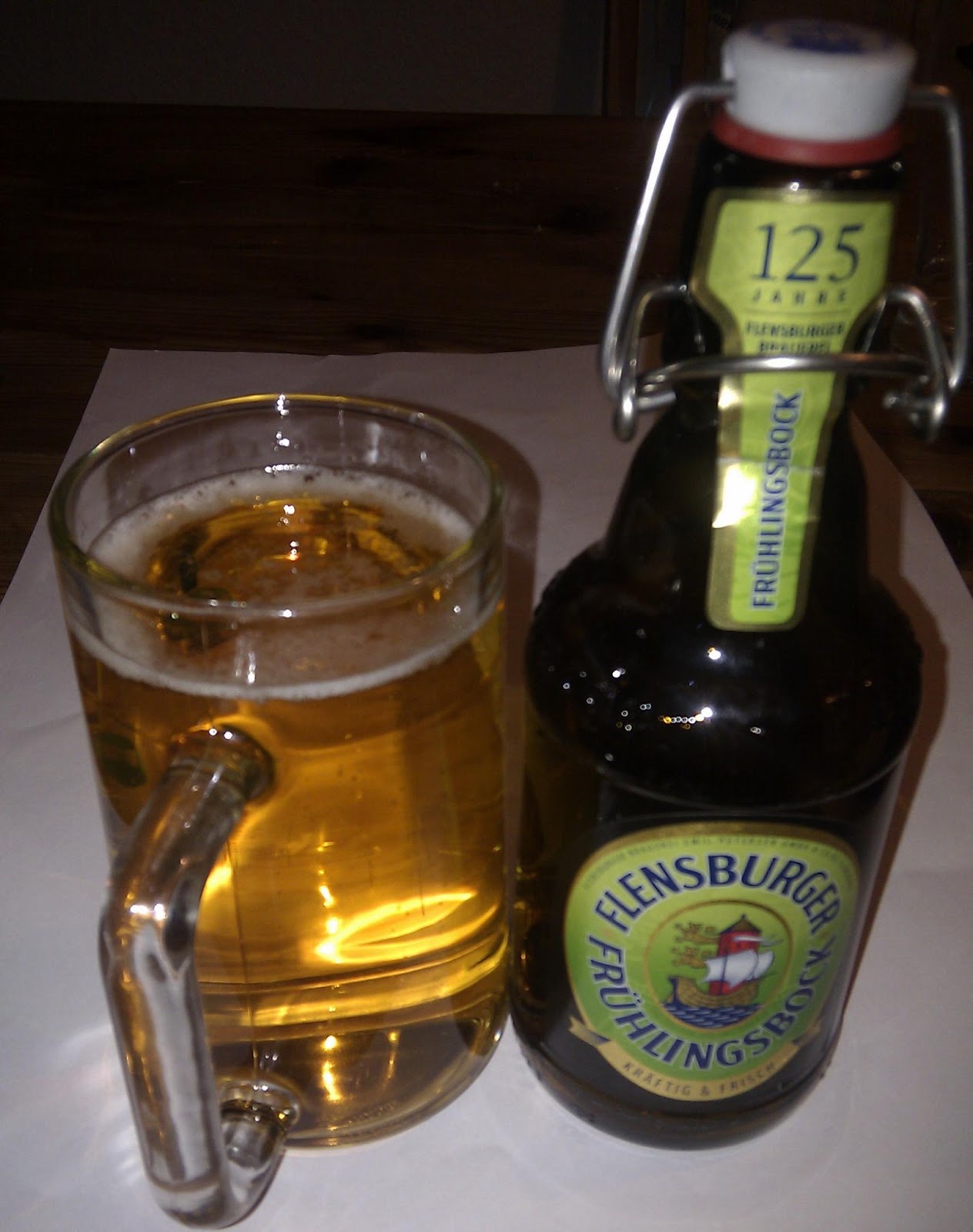
It's spring – at last, after what seems like four months of snow and ice. That's not a lot to the Canadians and Scandinavians out there, but it is for northern Germany. Finally we can really enjoy the Maibocks that have been
impatiently sitting on the shop shelves since mid-February.
Yes, in Britain it's the easter eggs that arrive two or three months
early, in Germany it's the seasonal beers....
![]() |
| A few Maibocks, left-right is roughly north-south |
Maibock is a relatively
recent addition to the German beer canon, although it is recognisably
part of the wider Hellesbock
(pale bock) family*, and is quite similar to Dutch Lentebock. Most of the
Maibocks I see are Nordisch (Northern) ones – not too surprisingly,
given that we're less than 100 miles from either the Baltic or the
North Sea – but there are quite a few Bavarian Maibocks too.
However, in the south they must compete with the tradition of Märzen,
which historically was brewed up until April. For example. the Osterbiers (easter
beers) I see from down south are mostly Märzens.
Also called
Frühlingsbock (spring bock) by some, Maibocks are malty, but
typically hopped up, drier and a little more bitter than other
Hellesbocks. They range from amber to gold, and the hoppiness is
often spicy, green, maybe lightly pine or citrus – and yes, it is
intended to make you think of spring.
Certainly, the
Einbecker, Dithmarscher and Flensburger examples are very much in
this mould. There are exceptions of course – for instance, the
Maibock from Vielanker, a microbrewery in Mecklenburg, just the other
side of what was the Iron Curtain, is perhaps more like a Märzenbock,
if such a thing is possible. (And if it's not, why not?!)
As I mentioned, look
south and things change a little – the Maibocks are often maltier
and, well, Bockier. Some claim this relates to a tradition that late
April and May were the times when the first new Bocks of the year
were tapped, though as with so many German "traditions" I'm
not wholly convinced, especially since we have Doppelbocks and
Winterbocks through January and February. It could well be that the
fresh Bock of May is inevitably a hoppier beast than the aged Bocks
of winter, I guess.
And no, I don't know why the northerners seen above are all 33cl stubbies while the southerners are 50cl long-necks. Nordisch quirkiness versus stolid Bayerish tradition, I suspect!
*Some people argue that Hellesbock (or Hellerbock) and Maibock are the same thing. I disagree – not least because Maibock is seasonal in availability, whereas the likes of Andechser Bergbock Hell are available year-round.
Friday, 12 April 2013
Historic barley revived for CAMRA weekend
| Chevallier grains |
British plant geneticists have revived
a Victorian barley variety, and used it to brew a "heritage
special bitter". The barley, called Chevallier, was revived from
seed in the genetic resources unit of the Norwich-based plant research institute, the John InnesCentre. JIC scientists collaborated with Sunderland University's
Brewlab to evaluate Chevallier - apparently it has "valuable
disease resistance that can prevent contamination of grain with
mycotoxins, which are a concern in the malting industry."
| The historic brew |
They went on to grow half an acre of
the grain, which was floor-malted by Norfolk's Crisp Malting Group
and then sent to Stumptail Brewery who turned it into a 4.7%
nut-brown ale with "a rich malty flavour and a lasting bitter
finish." The ale is being launched next Friday in Norwich, to
celebrate the start of CAMRA's annual member's weekend in the city.
Old varieties are a rich source of new
genes, and the JIC scientists revived Chevallier as part of a barley
improvement project, said crop geneticist Dr Chris Ridout who lead the project.
Historic records indicate that the variety produced premium quality
malt and good yields.
"We wanted to find out how the
variety performed, what the malt was like and how the beer tasted,”
he said. He has now registered Chevallier as a conservation variety,
and received a £250,000 grant from the Biotechnology and Biological
Research Council (BBSRC) to explore its commercial potential.
Sadly I can't get to the CAMRA AGM, but maybe I will get a chance to catch up with this beer later. It's certainly a fascinating project - I think John Keeling of Fuller's said that when they started doing historic recreations, the closest they could get was a barley variety from the 1920s. The JIC work potentially takes us right back to the Victorian heyday of Porter.
Saturday, 30 March 2013
A grand day to be indoors with craft beer
The location for the second Craft Beer Day – an old limestone factory converted into an arts centre, on the icy and windswept shore of a lake in a distant suburb of Hamburg – seemed unpromising to me. Yet by the end of last Saturday, around 2500 people had made their way there to enjoy a fine variety of good beer, plus good food and music, and of course good company.
Around a dozen breweries took part, I think all were northern German except two: Schneider Weisse from Bavaria, and Black Isle from Scotland. (The local newspaper coverage of the latter was amusing – the writer seemed amazed that "the land of whisky" should also produce beer.) The northerners ranged in size from Stralsund's Störtebeker – formerly the Stralsunder Brewery – which is now up to 100,000hl a year, according to brewer Christoph Puttnies, to hobby-brewers turned professional (or semi-pro) such as Grönwohlder, Sommerbecker and Zeugenbräu, the latter producing just 50 litres at a time.
The one thing they almost all shared, apart from not being factory brewers, was an interest in challenging the conservative monoculture of mainstream German beer – the popular assumption that Beer=Pils/Helles, and is more for quaffing than tasting. I was particularly amused when Grönwohlder boss Torsten Schumacher said no to visitors asking for Pils, telling them he was presenting only his Dunkel and Landbier on draught. He told me afterwards that he makes Pils mostly for the supermarkets – he said his other beers are unfiltered and don't have the required shelf-life.
I suspect that people coming to a craft beer festival and looking for Pils shows that the German craft beer movement is sending out mixed messages. On the one hand, there are people pushing the historical, experimental and creative sides of brewing, while on the other are people using the term simply to mean local and non-industrial production of Pils and Weizen. Can the two co-exist? I guess we have to hope so, and that the latter will gradually shift towards the former.
There were certainly signs of this happening among the breweries present at Craft Beer Day. Most had a had a variety of flavoursome beers on offer, including an excellent Stout and a rather nice Rauchbier from Finsterwalder, a classic Winterbock from Klüver's, and a tasty Porter from Privatbrauerei Bosch. Ricklinger, who I met at the first Craft Beer Day, was also there with a great range of beers. Most brewers had Dunkels and several had a Porter or Stout as well – I had a chat too with Christoph about the similarities between Baltic Stout and his excellent Störtebeker Stark-bier, which is technically a Doppelbock.
As well as all the good beer, it was wonderful to meet and talk with some really creative German brewers. Perhaps the most experimental is Zeugenbräu's Boris Georgiev – his proud motto is "Guaranteed not brewed according to the Reinheitsgebot", as he creates new twists on ancient North German spiced and fruit beer traditions such as beer with mango or spiced with cardamom.
I also had a great chat with one of the event's organisers, Axel Ohm of Ratsherrn Brauerei. I have to confess I wasn't too impressed with Ratsherrn when it started out – it seemed to be taking a very cautious let's-not-frighten-the-horses approach, with a beer range led by yet another Pils and a decent but not inspired Pale Ale. More recently though it has struck out a bit, with Iggy Hop, which is a single-hopped Weizen using American Simcoe hops, and now a crisp Zwickel too. Axel confirmed that there has indeed been a policy shift, with the realisation that there really is a market for something a bit different. We also talked about how different it is compared to the south of Germany, where the dead hand of tradition is so cold and heavy that breweries are almost scared to innovate.
One final highlight was discovering another tradition on the Schneider Weiss bar: mulled weissbier – or more accurately, mulled weizenbock. Beer sommelier Timo Hinkel took a special red-hot poker called a bierstacheln, or beer-sting, and plunged it into a glass of Unser Aventinus; instantly the beer began to foam as heat shock threw CO2 out of the liquid, along with an aroma of toasted caramel.
The resulting drink was fascinating – perhaps the oddest part was feeling the still-cold upper foam on my lip while drinking warm beer from below, with flavours of toasted bread and burnt caramel. I know ale was mulled with red-hot pokers in medieval England too, but sad to say I've never tasted that version, so this was a new experience – and one I'd like to thank Timo and the Schneider team for.
![]() | ||
| Grönwohlder and Zeugenbräu |
The one thing they almost all shared, apart from not being factory brewers, was an interest in challenging the conservative monoculture of mainstream German beer – the popular assumption that Beer=Pils/Helles, and is more for quaffing than tasting. I was particularly amused when Grönwohlder boss Torsten Schumacher said no to visitors asking for Pils, telling them he was presenting only his Dunkel and Landbier on draught. He told me afterwards that he makes Pils mostly for the supermarkets – he said his other beers are unfiltered and don't have the required shelf-life.
I suspect that people coming to a craft beer festival and looking for Pils shows that the German craft beer movement is sending out mixed messages. On the one hand, there are people pushing the historical, experimental and creative sides of brewing, while on the other are people using the term simply to mean local and non-industrial production of Pils and Weizen. Can the two co-exist? I guess we have to hope so, and that the latter will gradually shift towards the former.
![]() |
| Ratsherrn and Ricklinger, getting busy |
As well as all the good beer, it was wonderful to meet and talk with some really creative German brewers. Perhaps the most experimental is Zeugenbräu's Boris Georgiev – his proud motto is "Guaranteed not brewed according to the Reinheitsgebot", as he creates new twists on ancient North German spiced and fruit beer traditions such as beer with mango or spiced with cardamom.
I also had a great chat with one of the event's organisers, Axel Ohm of Ratsherrn Brauerei. I have to confess I wasn't too impressed with Ratsherrn when it started out – it seemed to be taking a very cautious let's-not-frighten-the-horses approach, with a beer range led by yet another Pils and a decent but not inspired Pale Ale. More recently though it has struck out a bit, with Iggy Hop, which is a single-hopped Weizen using American Simcoe hops, and now a crisp Zwickel too. Axel confirmed that there has indeed been a policy shift, with the realisation that there really is a market for something a bit different. We also talked about how different it is compared to the south of Germany, where the dead hand of tradition is so cold and heavy that breweries are almost scared to innovate.
![]() |
| Readying the bierstacheln |
![]() |
| and mulling the beer |
Monday, 25 March 2013
Dampfbier: the original Steam Beer?
![]() | |
| Zwiesels Dampfbier |
Many beer fans will have heard of Steam
Beer, a style claimed as native by California and now brewed only by
San Francisco's Anchor Brewing – in name at least, since former
Anchor owner Fritz Maytag was smart enough to trademark “Anchor Steam Beer” in
1981. Other Californian breweries now make it too, but as a style
called California Common.
What many will not know is that there
is another steam beer: the Dampfbier of eastern Bavaria
(dampf=steam). I came across a Dampfbier from Maisels of Bayreuth a
while back, then last Saturday I visited a drinks market that was new
to me and found a Dampfbier from the 1st Dampfbierbrauerei of
Zwiesel, which revived the style in 1989. (Ironically, these
two breweries are just 100km or so from Pilsen.)
And the legend of Dampfbier
is almost identical to the legend of Steam Beer – beer brewed for the
common folk, by brewers unable to use the refrigeration needed for
the newer cold-fermented Munich, Vienna and Pilsener lagers. The
notable difference is that Dampfbier uses a top/warm-fermenting
Weissbier or ale-type yeast, whereas Steam Beer uses a
bottom/cold-fermenting lager yeast but at ale temperatures.
American writers and their fellow
travellers (such as the writer of the Dampfbier history linked to
above) would have it that this makes them examples of parallel but
independent evolution. Indeed, Steam Beer is sometimes claimed as “America's only true native style”
– but what if that weren't true? What if the reality was that
Bavarian brewers emigrating to the US – Anchor's early brewers were
all German immigrants, for example – already knew of Dampfbier, and
faced with an inability to make the cold-fermented lagers that their
breweries had switched over to back home, they simply reverted to
those older techniques that they were still familiar with?
![]() |
| Maisel's Dampfbier |
Of course, using a different yeast does
produce a different result. It should be noted though that much else
is common to the two. Dampfbier is even lagered – matured in a cold
cellar – of course, like other warm-fermented Bavarian beers such
as Weissbier.
So what's Dampfbier like? Both the ones
I've tried are a reddish-brown or red-amber and malty, lightly hopped
with bitterness really only in the finish, and slightly sweet with
faint notes of caramel and nuts. The bottled Zwiesel example is a bit
fruity, with hints of melon, bread dough and bubblegum on the nose,
and touches of tart plum, bread and a faint wineyness in the body.
The Maisels one I've only had on draught, it has touches of peach and
banana on the nose and a smoother body.
I suppose if anything, I'd describe
them as a bit like a cross between a Dunkelweiss and a Brown Ale.
Which kind of makes sense, given the heritage. As you'd expect from a
modern American brew, Anchor Steam Beer is quite a bit hoppier, with
pine and citrus notes, yet it too is amber, malty, and a little sweet
with notes of bread and caramel or honey. Different, then, but not
that different. Interesting, eh?
Saturday, 23 March 2013
World's oldest preserved beer to be recreated at last
Another year, another press release following the 2010 discovery of "the world's oldest preserved beer" in a shipwreck
off the Åland Islands in the Baltic. In 2011, it was sending the beer off for analysis at Finland's VTT Technical Research Centre - here's the report I wrote on it then. In 2012, it was the release of their findings, which I covered here on the blog.
Now it is the news - well, it is more of a confirmation than news, given it submitted a request to do the brew right back at the start in 2010 - that local brewer Stallhagen is to try replicating the beer, and hopes to have something in production by June 2014.
Stallhagen is also the only microbrewery on Åland - indeed, it may be the only commercial brewer of any kind on the islands. Anyone who knows a bit about the economics and politics of Åland, which are somewhat local, to say the least, will be entirely unsurprised that the project has gone there rather than to a mainland brewery!
It's a fascinating project though, and I look forward to trying the results - especially as a portion of the profits will be going to local marine-oriented charities.
Thursday, 21 March 2013
Hamburg Craft Beer Day #2
I'm looking forward to this Saturday - it's the second Hamburg-area Craft Beer Day, taking place at Kulturwerk-am-See, a cultural centre in the suburb of Norderstedt.
The event's website isn't being updated, but the Facebook page is. The participant list currently appears to be:
Ratsherrn Brauerei
Ricklinger Landbrauerei
Finsterwalder Brauhaus
Grönwohlder Hausbrauerei
Propeller Bier
Sommerbecker Dachs-Bier
Klüver’s Brauhaus
Störtebeker Braumanufaktur
Blockbräu
Black Isle Brewery (yes, the Scottish one)
and some members of the HobbyBrau Hamburg home-brewers group.
Subscribe to:
Posts (Atom)