Showing posts with label Fuller's. Show all posts

Tuesday, 1 January 2019

What is bottle-conditioning – and why do we do it?

“Bottle-conditioned beers are not some sort of poor relation to cask, they exist in their own right,” declared John Keeling, former head brewer at Fuller’s, now retired. “A bottle-conditioned beer can never ever be the same as a cask beer, the reason is it will probably be a lot older.” He explained that while most cask beer has a shelf life measured in weeks, “most bottle-conditioned beers haven’t even left the warehouse at 6 weeks old!

“So it will have changed flavour, and secondly it will have more fizz in it. Bottle-conditioned beers are the supreme example of packaging beers. You do get some ingress of oxygen but the yeast mops it up – we opened a bottle of 1979 Vintage, for example, and the yeast was still viable.”

Introducing the panel
He was speaking at an event hosted by Marston's a few weeks ago, when a group of brewers and beer writers got together to discuss the past, present and future of bottle conditioning. We’d actually started by talking about the widespread assumption – fuelled in part by CAMRA’s ‘Real Ale in a Bottle’ (RAIB) validation scheme – that bottle-conditioned (BC) beers and real ales are the same thing.

Cask as a precursor

Was John Keeling right, though? Certainly there are clear links between real ale and bottle-conditioning. For a start, if you produce cask beer then it’s easier to do a BC version – you just bottle the cask version, said Harviestoun’s Stuart Cail. The advantage is that if you bottle it right – he uses big hand-bottled flip-tops – you can make it ‘premium’ and add a bit of theatre in a market where as he put it, “cask is not esteemed.”

Aged & conditioned Ola Dubh
Where it gets more interesting is when you use bottle-conditioning as just one step in a more complex process, he added. By way of example he offered a BC version of Harviestoun’s already highly regarded Ola Dubh (Black Oil) which had been aged in Highland Park whisky casks then krausened – dosed with fresh wort – to return it to life. The result was stunningly good, rich and heavy with a whisky tint, treacle-sweet yet burnt-dry, fruity and complex.

Along with John Keeling’s reminder that “in BC you get negative and positive reactions. They go in waves” as different microorganisms get to work on different components in the beer, it made me think: They’re both right, aren’t they? Yes, you can readily bottle beer brewed for cask, but that doesn’t automatically mean it ends up as ‘cask in a bottle’, because what happens to it next can be very different.

It certainly can be a route to ‘bottled cask’, as Marston’s brewer Pat McGinty explained. Marston’s wanted bottled Pedigree to taste more like the cask version, so its brewers had to do a lot of trials to work out the best way to achieve that. “We got way more of a fruited flavour when we put yeast in,” Pat said. “After a couple of weeks it had more carbonation, and was more recognisable as the cask beer.”

Something a lot of brewers (including Fuller’s) do is to filter and then reseed with fresh yeast for the bottle – preferably a different ‘sticky’ one that will settle to the bottom. Marston’s didn’t need to do that though, thanks to its yeast and the celebrated Burton Union fermentation system. “The Burton system traps the yeast and we can crop it nice and fresh,” Pat said. “It’s great for brewing but also perfect for bottle conditioning – most yeasts flocculate at the top but Marston’s yeast hasn’t made up its mind!”

He added, “Two weeks after we produce the beer, we bottle and cellar it. We put a 12-month shelf life on it, you can consume it beyond that but really its flavour will develop beyond [the intention of] the brand.”

Going through the four seasons

There we have it again – give it time and it’ll go further, even more so if you give it a bit of variation in storage, added John Keeling: “They would not have had temp control in the past. To me going through the four seasons makes sense, why not let it go the way it wants to go – and the way the outside temperature wants it to go?”

John told a tale about the development of Fuller’s Vintage Ale to illustrate the changes that time can bring. “When we developed 1845 [in 1995] we put one year shelf-life on it, but when we tasted it at one year old it was even better, so we had the idea of doing a vintage like you would with wine. Because the first Vintage Ale was 8.5%, we decided to put three years on it, we couldn’t put longer because the labelling regulations said you couldn’t. Now you can, and we put 10 years on!”

To illustrate, he offered tastings of the 2017 and 2010 Vintages. The former was rich and warming, fruit and lightly peppery, while the latter had picked up light oxidation notes – iodine, a little dry dustiness, a faint woody note – reminiscent of an old Madeira wine, in fact.

Not everyone filters and re-seeds the beer with fresh yeast, mind you. St Austell head brewer Roger Ryman told how they used to do that, dating back to his strong witbier Clouded White winning the Tesco Beer Challenge. “It was unfiltered in the competition – we had to ask if market was ready for that, and we decided to filter then reseed,” he admitted.

When the St Austell brewers subsequently tasted aged beers, they discovered that while others were showing signs of age, Clouded White was not. So then they did a BC Admirals Ale and two years later they added Proper Job to the BC list.

“It took three-or four years to find traction in the market, we were worried about its reception in the supermarket,” Roger continued. “Every brewer gets those unhappy Monday morning emails, ‘I bought your beer and found bits in it,’ but for every one of those there’s thousands of other happy drinkers.”

The challenge, he added, is once your beer is selling well and you’re on double-shifts at the brewery, how do you find time to filter and re-seed it? So Roger experimented with unfiltered beer instead, and luckily the yeast in Proper Job settled really tightly, yielding an excellent result. So after a visit to Marston’s to see what they were doing, he designed a set-up that blends yeast and beer in controlled amounts as it goes to the bottle-filler.

“We put quite a bit of automation around it, I thought it was unique,” he laughed. “Then I visited Westmalle, I’m looking at the bottling line – and there’s their yeast tank the same as I'd designed! So we brewers find the same solutions to the same problems.”

Ageing in cask – and in cans

But to come back to the original question, is bottle-conditioned beer definitively different from real ale? Well, yes – if you take today’s real ales as your examples. But historically, probably not because in the past any vessel could potentially be used to age beer. In the old days, stock ales were aged in wooden casks, often in the brewery yard. While it’s rare to age cask beers these days, it is sometimes done, and I’d argue the difference is as much to do with expectations as anything else – we expect cask ale to be fresh, not aged.

Moor's award-winning OFW is now can-conditioned
And cask-ageing is making a comeback – if, like some commentators, you regard cans as tiny kegs or casks… One of the pioneers here is Justin Hawke of Moor Beer, whose canned beers were the first to be accredited by CAMRA as real ale – that is, they contain live yeast, and the beer continues to develop (condition or referment) in the can.

“We had to work with the manufacturer on can-conditioning,” he said. “It was a bit crazy! We measure the sugar and yeast content in our lab, then we literally package the same beer into can and keg.” Justin added that refermentation makes the beer more stable, such that “unfined casks will keep for ages.”

He continued, “We go through a full refermentation, we crash-cool the beer pretty much to freezing to settle it out, then we warm it up in special temperature-controlled areas to get that refermentation to happen. It’s at least three weeks, some beers are longer – it’s a massive cost because we’re sitting on beer for an extended period, but it gives that evolution of flavour. My friends who brew tank beer will get the perfectly-fresh hop aroma that we will not get – our yeast interacts with the hops and changes the flavour. It gives a much more rounded mouth, you lose a little flavour but gain depth and shelf life and stability.”

The numbers game

The aftermath....
One thing is for sure – whatever the motivation, the popularity of bottle-conditioned beer shows no sign of abating. Jeff Evans, formerly editor of CAMRA’s Good Beer Guide, and more recently of the Good Bottled Beer Guide, pointed out that “at the founding of CAMRA, only five bottle-conditioned beers were known to be in regular production,” a decline which he argued had been driven in part by better bottling technology which made it possible to give people the clearer beer they wanted.

It can hardly be a coincidence that the number started growing again as CAMRA first introduced a BC category into its competitions, and then began listing BC beers in the Good Beer Guide. By the time the listing was spun off as the Good Bottled Beer Guide the number was well over 100, and by the most recent edition it was a shade under 2000.

Producing a new edition would be a daunting prospect. It would need to consider over 3000 from the UK, said Jeff, plus more from abroad, where some brewers have long preferred the softer texture of unfiltered live beer.

Would it be worthwhile – do people still seek it BC beer out, I wonder? Or it is a case of it’s expected or assumed that some will be BC? Let us know in the comments below… Happy New Year!

Friday, 5 October 2018

Fuller's micro is a model in many ways

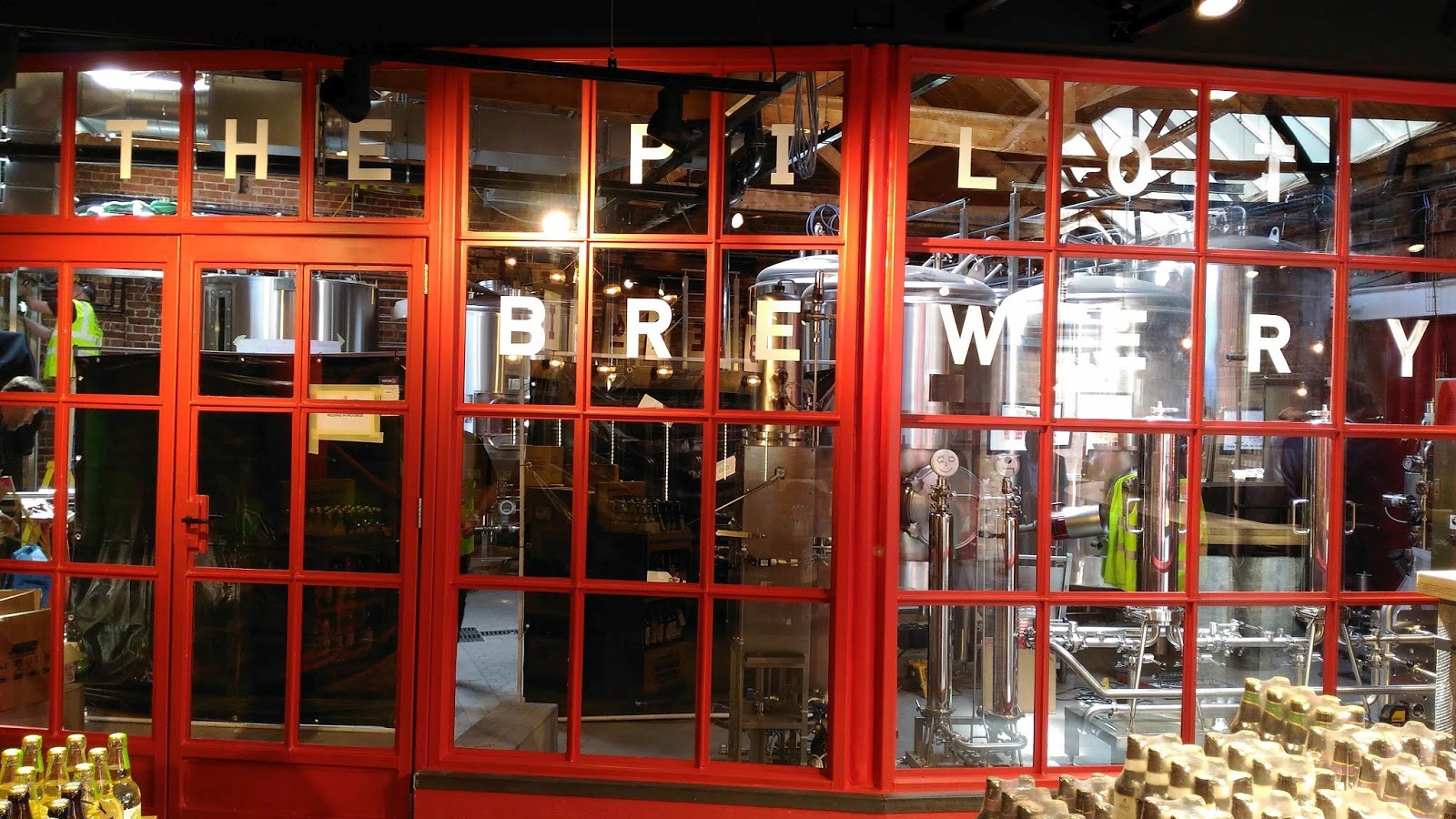
Visitors to Fuller's refurbished brewery shop have known for some time that a new pilot brewery was coming – you can see it behind a glass wall at the back of the shop. It was still under construction when the shop reopened though, and it didn't officially start brewing until quite recently.

Sadly, I missed the official opening, but when I read about it I wondered where the beers brewed there would end up. To find out, I of course looked on Untappd for check-ins and there they were, in the brewery shop. So one lunchtime last week I nipped over there for a look.

As I walked around the shop to see what I could find, I could also see through the glass a brewer, back turned to me, busily shovelling out the mash tun. I spotted several of the beers on the growler bar, available in two-litre takeaways, then looked up to see the brewer waving at me – it was Hayley Marlor (who was, incidentally, co-creator of Matariki, my favourite beer from the first Fuller's & Friends series which is back in the shops), and she invited me in for a look around.

The pilot brewery is built to more or less replicate the large one, so it includes items you'd normally not find in a 16hl/10 barrel microbrewery, such as a Steel's Masher. But it's also been given some features to make it more of a showcase (and incidentally easier to manage) such as a vertical window into the side of the mash tun. This means the brewer can see what's going on under the surface, and is rather unusual, to say the least.

Of course it can't replicate the main brewery exactly. For instance the volumes are lower, so you don't get the same hydrostatic pressures build up in the fermenters, and that changes how the yeast works. But it lets them come close, so as well as testing new ingredients and recipes it will help train new brewers on the main brewery processes.

Hayley said that as well as doing test brews and short-run beers, the brewkit will be used to pilot some of the future Fuller's & Friends collaborations. In particular, that's those with breweries overseas – with the UK collaborations so far, they've done the pilot batch at the partner brewery, then moved to Chiswick for the main production run, but that's rather less practical when the partner is half way around the world.

The idea is that each of Fuller's brewers will have charge of the pilot brewery for a year – Hayley was lucky enough to be the first. She expects to brew once a week to start with, and has already done several brews. Hopefully, as well as the growlers we'll see some casks and bottles available around London and at festivals before too long!

Saturday, 14 July 2018

Can cask ale avoid retreating into a corner?

I spent a pleasant hour or two last week with the folks from London's Moncada Brewery, formerly of Notting Hill and now of Dollis Hill (near Brent Cross in North London). They were holding a Meet-the-Brewer session at the George IV pub in Chiswick.

It's part of a guest-residency project Fuller's is running in a dozen or so of its flagship pubs with various other members of the London Brewers Alliance. Each month, Fuller's commissions two cask ales from another brewery – as far as I can make out, some are new brews, some are cask versions of existing non-cask beers, and others are regular cask beers. During its month, the brewer is also invited to visit those pubs with some extra beers in bottle or can.

The Moncada team at the George IV
So tonight we had Notting Hill Pale on cask, alongside Verano which is the new name for Moncada's summer ale – Verano is Spanish for summer. Brewers Angelo and Karl had brought along tall cans of two more beers. One was Mandarina Blonde, which is a version of the regular blonde ale single-hopped with, yes, Mandarina Bavaria. The other was a special version of Verano with two main changes – it too features Mandarina Bavaria in its hop blend, and it was fermented with a mixture including New England yeast.

What I didn't expect was that the mandarin notes would be more obvious in the mixed-hop beer than the single-hopped one. It's probably something to do with how the other hops combine to lift the flavours, suggested head brewer Angelo.

Needless to say, the cask beer at the George IV was in great condition, but one of the Moncada team, assistant brewer Karl, mentioned that they're winding back on cask and will produce it only for pre-sale in the future. The problem – despite all those seminars and training projects and cask ale reports and so on – is that too many publicans still can't look after real ale properly, and when they get it wrong it's often the brewer who unfairly gets the blame.

"How they treat our casks…" mused Angelo. "We delivered cask to one place in the morning, that afternoon we got a phone call: 'It's cloudy, I can't sell this!' It needs 48 hours to settle – no, they can't do that."

It's a story anyone in the trade has probably heard several times before, in one form or another. It's why some brewers have abandoned cask altogether, while others have told me they now sell it only to outlets they know and trust. And then there are those who are doing more and more brewery-conditioning of their cask ales – it's not a perfect solution, but it's an understandable one.

What does this all mean for the future of real ale – will it become a niche thing? Should it become a niche thing? Is the future 'fake cask', still real but with little left for the cellar manager to do? Let me know what you think, please.

Friday, 29 June 2018

London Brewers flourish in the midsummer sun

The queue, 2 min after opening
Last Saturday's London Brewers Alliance beer festival, in the brewery yard at Fuller's of Chiswick, was the best beer festival I've been to in a long while. Forty London brewers there – and I mean brewers, as it was a chance to meet the people who make the stuff – from breweries of all sizes and many ages, from recent 200-litre start-ups to well-established London regionals, all pouring their own beers in the hot midsummer sunshine.

Add in superb organisation by the Fuller's and LBA team led by John Keeling, who is both LBA chairman and director of brewing at Fuller's, and the LBA's John Cryne, and the day was complete: Plenty of bars (40 of them!) and all of the same size regardless of the brewery, plenty of tables and benches, supplies of drinking water, and of course plenty of portaloos – although quite how they also wangled the gorgeous weather I'm not sure!

It was only after John Keeling briefly stopped by our table, looking a little tired but sounding immensely relieved – "Everything arrived late, but we still opened on time," he declared – that I realised what an achievement this had been. Despite the quiet of a Saturday afternoon and the rustic charm of its old buildings, clad in historic Wisteria, during the week Fuller's is a working industrial site.

That means the festival build can't have started in earnest until after the brewery shut down on Friday afternoon, and after the Friday evening traffic on the Hogarth Roundabout had subsided. Indeed, David Scott of Kew Brewery said on Twitter that he was the first to deliver beer, at around 7pm.

Given that, it's no wonder that the vast majority of the beer was in keg form. Breweries were limited to two keg taps each, although some also brought cans and bottles, and a few – including the hosts – also had cask beer on a stillage in what I think of as the carriage house, opposite the brewery's reception office (it's the building straight ahead in the queue photo above).

I went with the intention simply of enjoying the beer, the sunshine and the company. Somehow though, old instincts were impossible to shake off and I found myself making notes as I chatted with brewers I'd not met before. Here's a few of the snippets I picked up…

Some of my beer-friends hadn't encountered ORA Brewing before, so wanted to find their bar. When eventually we did find it, I realised I'd been intrigued by their Balsamic milk stout before – so I asked for some more! Turns out ORA started as a homebrewery in a garage in Modena, Italy, but moved to London six months ago. They're brewing at UBrew in Bermondsey while they look for their own site.

Pietro said the Balsamic has 8g per litre of Modena barrel-aged balsamic vinegar – he's at pains to point out that this isn't the more acidic vinegar we're used to here, but a thick, sour-sweet and caramelly sauce that goes well with desserts and even ice cream. It explains both some of the creamy chocolate character in the stout and the faint tartness that I noticed when I first had the beer, which made me wonder then if it had been vat-aged.

Jeffersons Brewery I'd read about briefly in London Drinker, and I was curious because even though I'd not seen their beer before, it turns out they're more or less local to me, over the river in Barnes. It's just a 200-litre nanobrewery for now, run by the Jefferies brothers – I talked with George. It was great to hear from him that everything they do is real ale, even the kegs and cans – the Across the Pond session IPA was certainly in good form.

Somewhat unusually – several others I spoke to at the festival mentioned using mobile canners, such as Them That Can – Jeffersongs do their own canning on a small can-seamer (sealer). George had good news and bad – they're upgrading to an eight-barrel plant, but can't find a brewery site anywhere around Barnes. They don't want to go far though – "We will probably end up in Putney or Wandsworth," he said.

There were a few breweries that were completely new to me. One was Neckstamper Brewing, set up two years ago and now producing some fine IPAs – I tried both the Elbow Crooker Session IPA and the Mizzle New England IPA. "It's me all on my own, trying to balance brewing and selling," said brewer Adam Jefferies (yes, another one!). He now has a Saturday taproom open as well – had we known, we could possibly have added it to the other week's brewery crawl. "We're not far up the river walk from Beavertown and Pressure Drop," he said.

Two Tribes is a brewery name I knew, but without any idea where they were from. Turns out it's mostly based in Horsham, where it grew out of King Beer (and before that WJ King) and still has the 25-barrel commercial brewery. However, it also acquired a brewery site in Kings Cross not long ago for its taproom and experimental brews, and this now seems to be its HQ. On tap were Non Binary, a passionfruit Gose, and To The Bone, a Vienna lager, both of which were decent. 

Lastly for now, Spartan Brewery I visited on my last trip to Bermondsey, but at that point it was an almosth-empty railway arch. They've now got their brewkit in, and as brewer Colin proudly told me, "We did our first brew two weeks ago." He was also making a bid for the freshest beer at the festival, as it has only been kegged at 5pm the previous afternoon!

Well, that's all the ones that were new (or mostly new) to me; there were of course about three dozen more, many of whom I also paid a drinking visit to...

Monday, 11 June 2018

Fuller's brewery shop is much refreshed

When Fuller's brewery shop closed a few weeks ago for refurbishment, I wondered what it might open as. Would they go full-on craft beer store, with beers from their friends and so on, or would it just be a paint-job and some new furniture? So when I saw on Twitter that it was reopening today, I jumped on my bike to have a look.
It doesn't look that different from the outside at first - it's been a sunny day, so the inside looks a bit gloomy. However, if you peer closely you can make out the first change - it has expanded inside to the right of the main entrance, into the space behind the old door labelled The General Store.

This space is the new wine shop, looking much expanded and also housing both the glassware and souvenirs.

Behind the doors at the back is a space fitted with a boardroom-type large table and a big screen. Its curved wooden walls are to put you in mind of yes, a Tun Room, as it says on the doors, and it is a meeting venue that'll be available for hire.

At the front by the windows, there's a fridge with assorted beer-infused food items, from cheese and sausages to sticky toffee pudding!

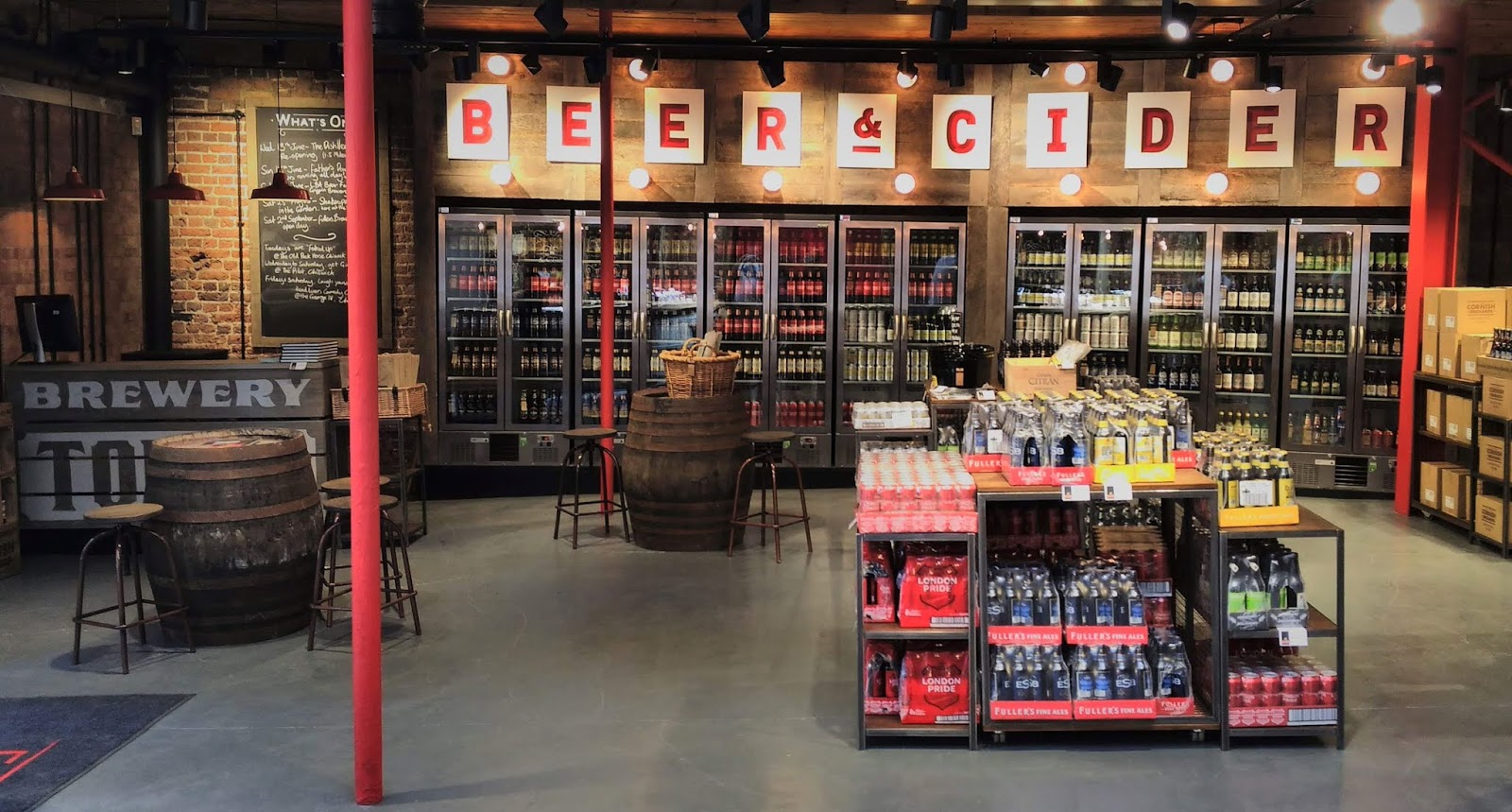
Back in the main space, almost the whole of one wall is now bottle and can fridges. The desk at the left (where there's also a blackboard for events listings - key ones to watch out for are the London Brewers Alliance beer festival in the brewery yard on Saturday 23rd June, and the Fuller's brewery open day on Saturday 2nd September) is the meeting point for brewery tours.

In the fridges, it's mainly products from the Fuller's family, so that includes some Dark Star bottles, Cornish Orchards ciders, plus some of the others that Fuller's distributes - that's bottles from Sierra Nevada and Chimay. Being able to sell these all in cooled form will please many, I'm sure.

Opposite that is, to some surprise given that the Mawson's Arms is just a few doors away, is a bar, featuring four handpumps and several keg taps! There's no glasses though, and you can't drink here - it's just for filling growlers. There's even a special machine to flush the growler (which is basically a large screwtop bottle) and if keg, to add a bit of pressure after filling.

Here's Paul, the general manager, demonstrating the filler (right). Apparently the new shop is going to be the centrepiece of Experience the Works, the new Fuller's "visitor experience".

A word on the growlers - these reusable take-away flasks are an idea that's hugely popular in the US, which may be why the Fuller's ones are the somewhat unusual size of a tad over 3.5 pints. Sharp readers will have guessed that's because they are actually half a US gallon. Anyway, an empty growler is £12 and then fills and refills are in the vicinity of £8, depending on the beer.

But it's at the back of the shop, past the bar, that you can see the pièce de résistance: Fuller's long-anticipated pilot brewery, all gleaming steel - and yes, fitters in fluorescent waistcoats, as by the look of it, it's not quite finished yet...
As you might expect, the plan is to use this both for trial brews and for short-run and special release beers - there's already at least one Twitter thread asking for suggestions. I know the brewers are very much looking forward to getting their hands on the new brewkit - and I'm looking forward to getting my hands on the results!

Monday, 4 June 2018

A Goose on the Thames

2018 is Goose Island's 30th anniversary, and last week, Fuller's – which was a major inspiration in the Chicago brewery's founding – threw its young cousin a birthday party in London. Pride of place went to the 30th Anniversary Ale, a 5.9% collaboration brew based on Fuller's original ESB recipe, but with modern and experimental US hop varieties.

It's a beer that's been available in the US since early May, but not here – kegs were brought over specially for the party at The Hydrant, a Fuller's pub named for its location next to the Monument to the Great Fire of London. Also getting a relatively rare draught outing there was Fuller's 2017 Vintage Ale in cask, so I'm afraid my first question for Goose Island president and general manager Ken Stout was: how come the Anniversary Ale isn't in cask too?

"We do quite a few cask beers, but the only place we serve them is in our own brewery tap," he said. He explained that it's the same problem so many British craft brewers have with cask beer – you're totally reliant on the skills, or lack of them, of the pub cellar manager.
The Anniversary Ale, very nice with a sossie!

I'd just come from a CAMRA meeting where those who couldn't get to the recent AGM (where votes were taken on adjusting CAMRA's aims to widen its campaigning remit and educational coverage) could hear and discuss reports from delegates who were there. So Ken and I went on to talk about why there's still this perceived divide between cask and keg – he's a big fan of British cask ale.

He loves classic Bavarian beer too, so we also talked about what's going on with German craft beer (with almost everyone now making Pale Ale and/or IPA, German and even Bavarian PA/IPA have emerged as genuine substyles, but the aficionados and beergeeks have moved on to Porters and Stouts, preferably barrel-aged Imperial ones…); about Franconian Ungespundet which is Germany's equivalent of cask-conditioning; and about Goose's collaboration with fellow AB-InBev property Spaten last year. The resulting Keller-Märzen was served at the Goose Island London Block Party last September, and like the party it was excellent.

It got me thinking: here's two macro-owned breweries, but they're still making great beer, and they seem to be getting nothing but help and support from their owners. Is this, and not the dumbing-down that many assume will follow when you 'sell out to big beer', the real threat from macrobrewers buying into craft? That the result will be too good – or at least, plenty good enough – and too well resourced for others to compete? I'm going to have to think (and write) some more about this…

Ken also introduced me to Andrew Walton, the newly appointed head brewer for Goose's Shoreditch brewpub, which is due to open in September – there's already brewpubs in Toronto, Seoul and Shanghai, as well as the original one in Chicago of course, and we're next. Andrew is from Canada, but has spent the last couple of years brewing in London, at Fourpure.

Samples of Belgian-brewed Midway are air-freighted back to Chicago so they can be tasted for consistency with the US version. If there's one thing companies like AB-InBev understand and can help their craft brewers with, it's expertise in quality and consistency management. Interesting times, eh?

Sunday, 12 November 2017

Waitrose plans a beery splash with Fuller's & Friends

Waitrose is the place to shop tomorrow, or so it seems! The upmarket retailer has snagged itself a bunch of interesting beer exclusives, and Monday 13th November is when they’re due to arrive on the shelves. (edit: maybe wait until later this week before going in - if my local branch is anything to go by, they'll go on the shelves as and when the delivery happens and the staff have time...) It’s not just the Fuller’s & Friends mixed six-pack of collaboration brews, which I’ll write more about in a moment – the others I know of are two more bottled Fuller’s beers, namely the 10.7% Imperial Stout 2017 and Vintage Ale 2017, and an exclusive beer from Thornbridge.

The latter is a Gose made with watermelon juice. Originally brewed by Londoner Josh Smith, it was the winner of the Waitrose-sponsored 2017 Great British Homebrew Challenge, and one of the prizes is this competition is to have your beer brewed commercially by Thornbridge. The beer’s name, Mr Smith Gose To…, references both its brewer and the 1939 Frank Capra film, ‘Mr Smith goes* to Washington’.

By coincidence, I met Thornbridge’s head brew Rob Lovatt, who was one of the Homebrew Challenge judges, at the launch of Fuller’s & Friends – he is also one of the latter. He noted that one of his aims with the 7.1% Fuller’s/Thornbridge brew, a Red Rye Ale named Flora & the Griffin after the two breweries’ mascots, was that it would age well in bottle – all six F&F beers are bottle-conditioned.

Explaining the F&F project, Fuller’s head brewer Georgina Young said that although the idea came from her predecessor John Keeling, who is now brewing director and brand ambassador, a lot of the drive behind F&F came from Fuller’s marketing department and from Waitrose itself – after all, you can’t do something like this if you don’t have an outlet for the results.

Essentially she paired each of her six brewers with another brewery, each pairing discussed what they would brew, where possible they did a pilot batch at the other brewery – these were the beers that appeared in cask at London Craft Beer Festival and a few other places back in the summer – and then they brewed and bottled the full production batches at Fuller’s during the autumn. “My team have really shown their capabilities, working with their partners,” she said, adding with a grin: “I haven’t been involved in brewing any of the beers, I just wielded the big stick!”

She presented the six, and their brewers, more or less in order of ABV, so first up was the 4.8% collaboration with Fourpure, which is also the only lager in the set. Some have already given Galleon dry-hopped lager the new-fangled tag of India Pale Lager, or IPL, but it’s much more about aroma and flavour than bitterness. The brewers were keen to use the new Loral hop; it has floral qualities so they then paired it with the grape character of Nelson Sauvin hops.

I’ve had dry-hopped lagers before so wasn’t expecting a lot, but Galleon – the  beer's name is meant to reference the meeting of old and new on the Thames – really impressed me, especially as I was incredibly lucky to try it cask-conditioned from a handpump, as well as in bottle.

As Georgina explained, “We thought for fun we’d run off a firkin [cask] of each beer. I’m not sure it’s right for all of them…” Well, I don’t know about the latter, because this cask lager was excellent – fresh lemony malt overlaid with spicy-sweet and floral hops, and a mild pleasing bitterness. It’s also quite possibly the first cask beer that kegophiliac brewery Fourpure has ever produced, and it showed just what they are missing by shunning cask.

Georgina introduces the Matariki brewers,
Fuller's Hayley and Marble's JK. 
Next up was what was probably my favourite of the six, albeit just a nose ahead: Matariki, a New Zealand Saison brewed with Manchester’s Marble. Dry-sweet and lightly funky, with notes of golden malt and grapes, it was best on cask which gave it a slightly creaminess, but is still jolly good in bottle. Its name is a nod to the seasonal origins of the style, said Hayley Marlor, the Fuller's half of the collaboration – Matariki is the New Zealand name of a constellation that appears around harvest time.

Rebirth, the 6% collaboration with Bristol’s Moor Beer that takes the original 1971 recipe for Fuller’s ESB and gives it a 21st century twist, was the only one I’d already tried on cask back in the summer. Where that version was lightly resinous and jammy, with herbal bitterness, this one is more toffee and marmalade, with bright hoppiness. "We did tweak the recipe slightly as we had it too dark, but it is the same beer," said Moor’s Justin Hawke, adding that the other difference from the pilot is of course that he brews all his beers unfined.

He added that, coming from the US where Fuller’s ESB is a classic that has spawned an entire beer style, “I had expected it to be 100 years old, and was surprised to find the first brew was only in 1971!” The ESB recipe has been revised since then, bringing the ABV down and eliminating the adjuncts to make it all-malt. Said Justin, “The old recipe has US, Australian, Slovenian and UK hops, so we decided to update it to what it could be if it used fresh hops from those countries today.”

I’ve already mentioned Flora & the Griffin – it’s sweet and faintly tart, with hints of caramelised and spiced nuts – so next up is the 7% New England IPA, a collaboration with Manchester craft beer darlings Cloudwater. NE IPAs are all about thick hop flavours and aromas, rather than bitterness, so as Fuller’s Henry explained, the planning for this was all about how much hops they could get in at every stage of the process: “It was, would we still be able to empty the fermenter if we put in 80 kilos? At every point I’m thinking ‘Will this beer get out of this vessel?’ – and it did!”

A notable oddity is that where NE IPAs are usually cloudy, this one came out clear – “I don’t know what happened there,” said Henry. I checked though, and it was also one of only two beers in the set that weren’t pilot-brewed. The justification was that Cloudwater rarely repeats its beers, but I fear it showed. It’s definitely not a dud – it’s a nice beer, richly hoppy and fruity-crisp – but I suspect it’s not what it could or perhaps should have been.

Also 7% but saved for last as it is both the only dark and the only smoked beer in the set, is Peat Souper, a collaboration with Cumbria’s HardKnott that was designed as a way to make HardKnott’s impressive Rhetoric #4 12% Imperial Stout more accessible by hybridising it with Fuller’s Black Cab and London Porter. And amazingly, it works! If you know the three beers, you can detect them all in there - rich and lightly smoky Rhetoric, chocolatey Black Cab and faintly roasty and vinous like the London Porter.

Hardknott’s Dave Bailey said the biggest problem had been the amount of notoriously pungent peat-smoked malt in the recipe, which Fuller’s staff had worried would taint subsequent brews in the same vessels. They suggested halving the amount, but he stood firm and eventually won – they had to start at 4am as the last brew of the week, but were able to use the peated malt because the brew was timed just before those particular vessels had their six-monthly overhaul and extra-deep clean.

All in all, Fuller's & Friends is an impressive project. The beers demonstrate variety and innovation, yet at the same time they are all about accessibility and drinkability, rather than pushing the extremes. Not every brewery can achieve that, but as Rob Lovatt noted, “I have great respect for Fuller’s. Drinkability is something Fuller’s has down to a tee, and other brewers could learn a lot from that.“

The value for Fuller's – which as Georgina Young says, now "embraces doing collaborations with partners big and small" – seems clear too. Of course, the big thing is the marketing opportunity, and you can certainly see why they're pitching the boxed set as an ideal Christmas gift for the beerily-inclined!

But there's also the 'rising tide that floats all boats' aspects. All the brewers involved seem to have learnt something, whether it's guests who normally brew on something eight or ten times smaller and non-automated, or Fuller's brewers who had never manually dug out a mash-tun before! And just as importantly, they all appear to have had a great time. 


*I’m afraid that when I see attempted puns like this, my first thought is that someone doesn’t know how to pronounce Gose (hint: “Go-ser”). Ah well, never mind – I plan to buy and try the beer anyway! 

Sunday, 6 August 2017

Fuller's & Friends at the Cask Yard

Pic: Fuller's
By all accounts, “The Cask Yard” at this weekend’s London Craft Beer Festival has been a great success. As last year, it’s presented and anchored by Fuller’s but features others too – not just cask ale from Sierra Nevada (Fuller’s distributes SN beer in the UK) but also the likes of Redemption, Thornbridge and Wimbledon.

It’s quite a change from the first LCBF events when there was cask, but nowhere near as prominently. Given the major part real ale plays in London brewing, a big cask presence is entirely fitting – no, entirely necessary!

It’s also been the first public outing for a project I heard about in confidence a few weeks ago – Fuller’s & Friends. Fuller’s brewers have been working with colleagues from around the country on a new set of collaboration brews. So far we’ve seen four of what I’m told will be six beers:

#1 – Flora & The Griffin, a 7.4% rye ale, collaboration with Thornbridge.

#2 – Rebirth, 6% “the original 1971 ESB reborn”, a collaboration with Moor Beer.

#3 – Big Smoke, a 7% smoked Porter with Hardknott.

#4 – Matariki, a 5.5% New Zealand Saison with Marble.

Two more to come, then – possibly during today’s final LCBF session. Sadly, I’ve neither a ticket nor the time to get over there this afternoon, but I’m hoping and expecting that all will also be on draught at this week’s Great British Beer Festival. My information is they will then be bottled and sold as a package.

Edited Addendum: Sadly I didn't see any of them at GBBF, but there's also visits from Cloudwater and Fourpure mentioned now on Fuller's Twitter feed, so I guess they are the 'missing' two that'll make it six.

More usefully, I've now heard from a second source that the six-pack will be sold exclusively through Waitrose. True or false, my Fuller's friends?