Showing posts with label london brewing. Show all posts

Tuesday, 14 July 2020

Fuller's pubco to flog its brewery tap, as it moves upriver

The Mawson Arms (source: Fuller's)
Fuller's pubco is permanently closing the Mawson Arms/Fox & Hounds and putting it up for sale, according to reliable local reports. The pub is legendary for several reasons – as the Griffin Brewery tap and the watering hole for many brewery staff, for having two names*, for confusing people by closing at 8pm, and for serving the best Fuller's cask beer in town.

The Fuller's pub company's excuse for the closure is that it doesn’t need the pub now that its staff have moved out. But of course the brewery and distribution staff are still there, and Asahi UK has moved its staff up from Woking into newly-vacated offices at the Griffin Brewery, so there’s not exactly going to be a shortage of people in the area wanting lunch and a beer.

Sure, there’s the George & Devonshire on the Hogarth roundabout, but that’s not a brewery tap. And while Asahi can end future brewery tours at the bar in the brewery shop, instead of in the Mawson, there’s no food available there. 
 
Pier House
Meanwhile, Fuller's pubco has moved to Pier House by Kew Bridge. When first I spotted the new offices there, the red, black and gold Fuller, Smith & Turner lettering took me by surprise. I remember seeing this line of buildings – originally built as a laundry – being refurbished into offices a few years ago.

Of course, the staff now at Pier House lost their offices at the Griffin Brewery when Fuller’s owners sold the family silver for a mess of Japanese pottage. And Pier House does look the part, with the lettering on the facade and the brass company nameplates on the doorframes. Plus, they have an even clearer view of the river, just across Strand on the Green - and a short walk away is Fuller's Bell & Crown, which is also a reliable source of excellent cask ale.

The Mawson was always going to be in an odd position following the brewery sale – even though it was physically on the wider brewery site, it wasn’t part of the sale to Asahi, nor apparently were the adjacent houses (now offices) on Chiswick Lane South. When I asked pub staff at the time (pre-pandemic, of course), they only knew that the pub wasn’t part of the brewery sale.

So who would buy the Mawson, given that it’s Grade II* listed and not an obvious site for residential conversion? I can’t help wondering if the breadheads at Fuller’s are hoping to flog it to Asahi – it’s even possible that the Japanese didn’t realise it wasn’t part of the brewery purchase to start with.

Otherwise that’ll be another slice of London’s brewing history gone, and like so much else it’ll be the fault of locals who care less about our heritage than the Japanese do.

*Although the best-known version of the two-names story claims that the modern building was once two separate pubs, in the pub itself they instead tell a story of historical confusion. Apparently there was a time when you needed separate licences to sell beer and spirits, and an earlier licensee didn't realise that a single business could hold both, so he added the second name for the second licence. Believe whichever you like!  

Friday, 13 March 2020

WTF is Hard Seltzer?

Asking the important question
“WTF is Hard Seltzer?” asks the wittily-labelled can, before answering its own question: Alcoholic Fizzy Water.

The other thing to know is that it’s also the latest drinks craze to hit the US, where ‘hard’ is a euphemism for alcoholic. It’s so fashionable there that even beer rating site Untappd, which once allowed nothing but beer, cider and mead, now also permits you to list Hard Seltzers (alongside a few other oddities such as alcoholic Kombucha, which is fermented tea).

When first I came across the idea, I assumed it was the latest iteration of what in Britain and much of the rest of the world we call alcopops, and which the Americans of course call hard soda. That’s the likes of WKD and Hooper’s Hooch – sticky concoctions that concealed their alcohol content under a wave of sweetness, and came to be regarded by many as a Bad Thing that encouraged kids to get drunk.

Brick's Raspberry Hard Seltzer
Having at last tried a couple of London-brewed examples though, I can say I was only partly right. There’s a growing number of modern Craft Soda brands designed to be not quite as sweet as the average fizzy pop and more inventive in flavour, and some Hard Seltzers – such as Brick Brewery’s bright red Raspberry Hard Seltzer – are very much in that mould. Still a bit sticky-sweet, and with the 4% ABV well hidden, but properly fruity and tangy. Millennial hard soda, you could say.

However, when I opened the can of 5% “alcoholic aqua” gifted to me by London Fields Brewery at Brew//LDN the other week, it was very different. Yes, there’s dextrose (sugar) on the ingredients list, but that’s highly fermentable as the light and dry texture shows. Then there’s guava puree and red grape skins for flavour and colour – in this case that’s a blush-pink, and a dry and intriguing mix of tropical fruit and wine lees.

What a revelation – and definitely not an alcopop or likely to appeal to kids! Clearly, Hard Seltzer is something a creative brewer can have a bit of fun with. Indeed, London Fields admits in its promo material that its brewers "genuinely had no clue what hard seltzer was suppose to taste like" so they just had a play. Good on them.

My problem is that I've no idea yet which way the majority of Hard Seltzers swing, but given that many flavoured waters are actually sweetened too, I suspect they'll be the same. Sure, for non-beer drinkers the right one can be lighter than cider and a lot more quaffable than wine. I’m still not convinced though that they have a place on a beer website, and at least Ratebeer still agrees with me – for now, anyway.

What do you think – are you willing to give this stuff a try, and does it belong alongside beer and cider?  

Saturday, 16 November 2019

Changing your Signature

It's all change at London's Signature Brew following an oversubscribed crowdfunding campaign last year - new brewery and taproom, new logo and cans, and even a few new brews - new to me, at least.

The launch party at the new site is taking place this weekend, and there’s lots of shiny stainless steel on show. Given the brewery's history of collaborating with bands to create one-off beers, of course there's quite a bit of live music too.

There’s already a Signature Taproom in Haggerston, London E8, so the new site’s drinking space is instead called The Brewer’s Bar. For this weekend’s launch there’s also tables and benches in the yard outside and on the open area in the brewery proper - I’m told these will also be out once the Brewer’s Bar is open regularly, which is set to be Friday/Saturday evenings and Saturday/Sunday afternoons. At this time of year, the open areas are a tad chilly, but the bar itself is enclosed and warm!

Inside the bar there’s various mementos on the wall of the brewery’s history and its musical collaborations, from its origins in 2012 when it contract-brewed, to 2015 when they got their own brewkit, which they outgrew within four years.

I had a chat with Chris, one of the assistant brewers, who filled me in on some of the changes. Although the actual ‘brew length’ hasn’t changed massively - the new brewkit is 32hl (20 barrels) where the older was 24hl - the new one is much more modern. In place of a manual two-vessel system, they now have a four-vessel system with lauter tun and whirlpool, so brewing is easier and faster.

Alongside a set of 32hl fermenters, they also now have six 120hl (75 barrel) fermenters for core beers such as Roadie, Backstage IPA and Studio Lager - big enough to get three brews into each. They’re currently brewing three days a week, two or three times a day. One of the advantages of upsizing your brewkit is quite simply that you can produce more beer in a shorter time and with less effort!

The venue is family-friendly, too!
As for the beers, as I discovered when I first met them they’re quality brews. Alongside the regulars I found an excellent 3% hoppy modern bitter - they badge this as a Table Beer, but to my mind it’s more of a Pale Ale ‘light’, a gorgeous Bretted lager (sadly a very limited production run), and a modernist Farmhouse/Saison.

Then there’s the collaboration they did for the recent Brewdog Collabfest, which aims to cram a cream tea, complete with cucumber sandwiches, Earl Grey, scones and raspberry jam, into a hazy IPA. It sounds ghastly, but it’s actually complex and fascinating. They also have a cask containing some of the very last of their original Anthology 10% Imperial Stout, now two years old and tasting quite gorgeous.

Technically the weekend event is ticket-only, but I’m told there should be room for some extra visitors if you’re looking for things to do tomorrow! It’s an easy walk from Blackhorse Road station. Also in the area are the Wild Card brewery, although sadly that’s not open tomorrow, and the intended site of Exale Brewing, which is the new project - again, crowdfunded - from the former Hale Brewing team. Ex-Hale, yeah…

Many thanks to the Signature crew for inviting me over - cheers!

Sunday, 28 October 2018

Nationwide beer festival kicks off with London Brewing Co

The last time I visited London Brewing Co, it was a small brewkit in the corner of the kitchen at the Bull pub in Highgate. Now, it’s a 10 hectolitre microbrewery in its own space*, and it’s been appearing in 40 Nicholson’s pubs up and down the country as the opening act in that pubco’s Autumn 2018 Beer Showcase, which opened last month.

St Pancras IPA
“We’ve been brewing non-stop for this,” says LBC boss Senan Sexton. The brewery has produced 12 cask ales for the festival, some are their regulars and others are variants of previous brews, done specially for Nicholson’s.

Normally LBC’s production is 40% to 50% cask ale, rather than 100%, he says, adding that “Cask isn’t the most profitable, but it’s the most important. It’s low-margin for brewers but we’re not too worried as we can scale up and down.”

I met Senan, head brewer Richard, and second brewer George, at the Coal Hole on London’s Strand, where the pub’s staff had arranged a treat for us and a number of their regulars: a beer and food pairing, matching five beers with different dishes. The Coal Hole is a classic Nicholson’s pub, all dark wood and polished brass – very much an updated version of the image that many people will have of the classic English pub.

In fact I wonder if that “modern-traditional” style is why Nicholson’s pubs are so popular with their locals, yet often overlooked by others. Nicholson’s is part of pubco M&B, so sometimes it gets disparaged along with the likes of Punch and Enterprise. In truth though, its pubs are generally rather nice – and more importantly, they keep a very decent pint of real ale (or at least the ones I know do!).

The first beer we try is St Pancras IPA, brewed and named for the 150th anniversary this year of the railway station where barrels of beer arrived from Burton-on-Trent and were stored for onward distribution. It’s a lovely beer – toasty-sweet and malty-dry in what we now tend to think of as the classic English IPA style. It goes very nicely with the fried nibbles presented by the pub, with the caramel malt complementing the caramelisation in the batter.

Senan serves up the brownies
The other beers are just as good, from Admiral of the Red, a red ale that’s spicy and lightly tangy, through 100 Oysters, a dry Stout which is indeed brewed with 100 oysters and is complex and dark, to Gigglemug. The latter is a change of pace – after relatively rich cask ales, Richard wants to show he can do lighter keg beers too – this is a fruity and lightly floral American Pale Ale.

We finish with a bite of chocolate brownie to accompany Senan’s piece de resistance, Samson’s Riddle. A big and chewy 9.5% Imperial Stout that included black treacle in the brew, it’s been aged in Bourbon barrels before a couple of years of bottle conditioning. It’s good now, and should only improve – if you can find a bottle, that is.

Although technically LBC’s slot in the Nicholson’s Beer Showcase is over, I hear there are still ales available in some of the pubs around the country. It’d be a shame to miss them, but then again there’s plenty more good beer coming up – Siren is next, with a range that includes a number of specials.

*Still in a pub, but now it’s The Bohemia, in North Finchley.

Friday, 5 October 2018

Fuller's micro is a model in many ways

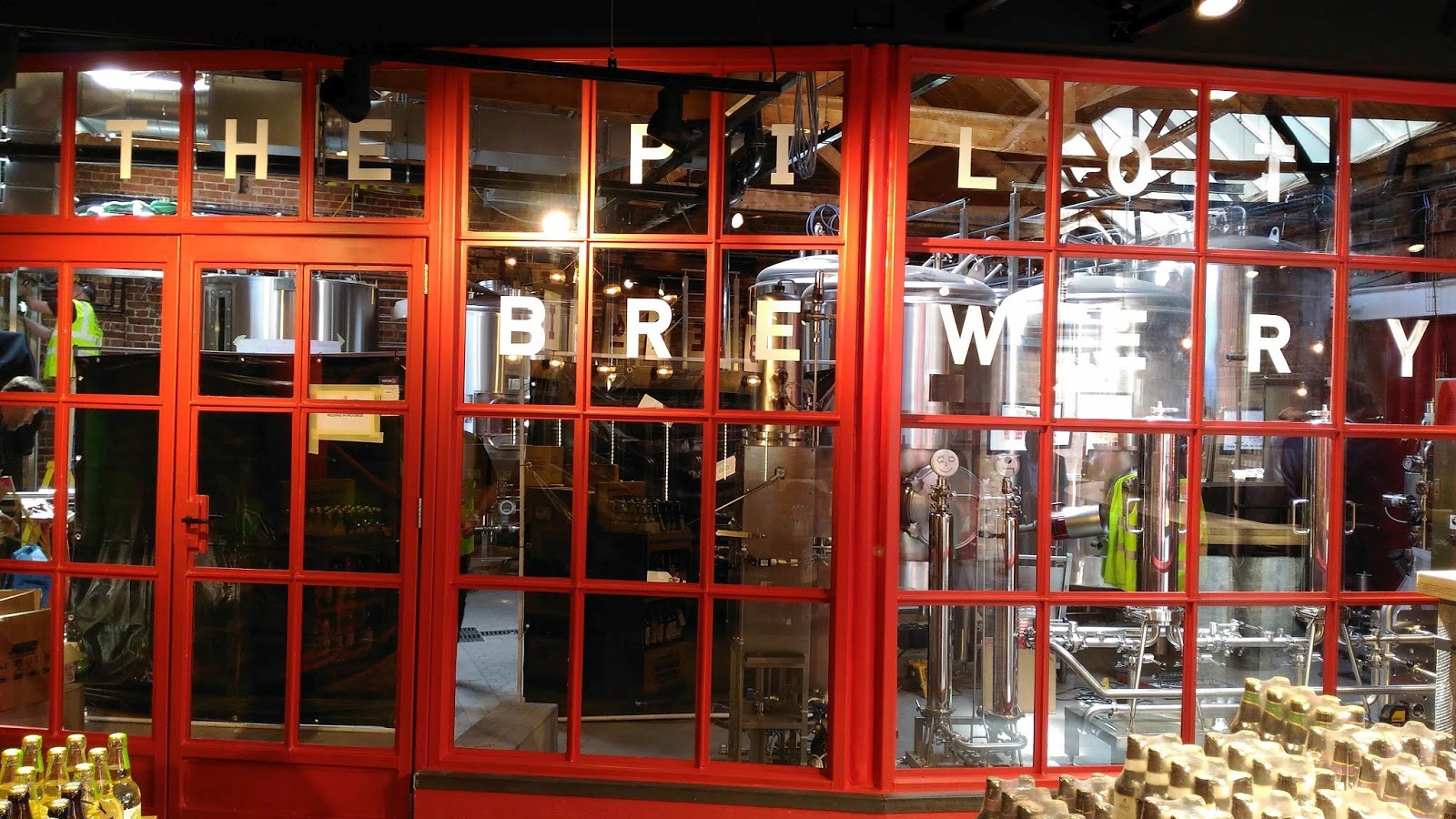
Visitors to Fuller's refurbished brewery shop have known for some time that a new pilot brewery was coming – you can see it behind a glass wall at the back of the shop. It was still under construction when the shop reopened though, and it didn't officially start brewing until quite recently.

Sadly, I missed the official opening, but when I read about it I wondered where the beers brewed there would end up. To find out, I of course looked on Untappd for check-ins and there they were, in the brewery shop. So one lunchtime last week I nipped over there for a look.

As I walked around the shop to see what I could find, I could also see through the glass a brewer, back turned to me, busily shovelling out the mash tun. I spotted several of the beers on the growler bar, available in two-litre takeaways, then looked up to see the brewer waving at me – it was Hayley Marlor (who was, incidentally, co-creator of Matariki, my favourite beer from the first Fuller's & Friends series which is back in the shops), and she invited me in for a look around.

The pilot brewery is built to more or less replicate the large one, so it includes items you'd normally not find in a 16hl/10 barrel microbrewery, such as a Steel's Masher. But it's also been given some features to make it more of a showcase (and incidentally easier to manage) such as a vertical window into the side of the mash tun. This means the brewer can see what's going on under the surface, and is rather unusual, to say the least.

Of course it can't replicate the main brewery exactly. For instance the volumes are lower, so you don't get the same hydrostatic pressures build up in the fermenters, and that changes how the yeast works. But it lets them come close, so as well as testing new ingredients and recipes it will help train new brewers on the main brewery processes.

Hayley said that as well as doing test brews and short-run beers, the brewkit will be used to pilot some of the future Fuller's & Friends collaborations. In particular, that's those with breweries overseas – with the UK collaborations so far, they've done the pilot batch at the partner brewery, then moved to Chiswick for the main production run, but that's rather less practical when the partner is half way around the world.

The idea is that each of Fuller's brewers will have charge of the pilot brewery for a year – Hayley was lucky enough to be the first. She expects to brew once a week to start with, and has already done several brews. Hopefully, as well as the growlers we'll see some casks and bottles available around London and at festivals before too long!

Saturday, 14 July 2018

Can cask ale avoid retreating into a corner?

I spent a pleasant hour or two last week with the folks from London's Moncada Brewery, formerly of Notting Hill and now of Dollis Hill (near Brent Cross in North London). They were holding a Meet-the-Brewer session at the George IV pub in Chiswick.

It's part of a guest-residency project Fuller's is running in a dozen or so of its flagship pubs with various other members of the London Brewers Alliance. Each month, Fuller's commissions two cask ales from another brewery – as far as I can make out, some are new brews, some are cask versions of existing non-cask beers, and others are regular cask beers. During its month, the brewer is also invited to visit those pubs with some extra beers in bottle or can.

The Moncada team at the George IV
So tonight we had Notting Hill Pale on cask, alongside Verano which is the new name for Moncada's summer ale – Verano is Spanish for summer. Brewers Angelo and Karl had brought along tall cans of two more beers. One was Mandarina Blonde, which is a version of the regular blonde ale single-hopped with, yes, Mandarina Bavaria. The other was a special version of Verano with two main changes – it too features Mandarina Bavaria in its hop blend, and it was fermented with a mixture including New England yeast.

What I didn't expect was that the mandarin notes would be more obvious in the mixed-hop beer than the single-hopped one. It's probably something to do with how the other hops combine to lift the flavours, suggested head brewer Angelo.

Needless to say, the cask beer at the George IV was in great condition, but one of the Moncada team, assistant brewer Karl, mentioned that they're winding back on cask and will produce it only for pre-sale in the future. The problem – despite all those seminars and training projects and cask ale reports and so on – is that too many publicans still can't look after real ale properly, and when they get it wrong it's often the brewer who unfairly gets the blame.

"How they treat our casks…" mused Angelo. "We delivered cask to one place in the morning, that afternoon we got a phone call: 'It's cloudy, I can't sell this!' It needs 48 hours to settle – no, they can't do that."

It's a story anyone in the trade has probably heard several times before, in one form or another. It's why some brewers have abandoned cask altogether, while others have told me they now sell it only to outlets they know and trust. And then there are those who are doing more and more brewery-conditioning of their cask ales – it's not a perfect solution, but it's an understandable one.

What does this all mean for the future of real ale – will it become a niche thing? Should it become a niche thing? Is the future 'fake cask', still real but with little left for the cellar manager to do? Let me know what you think, please.

Monday, 11 June 2018

Fuller's brewery shop is much refreshed

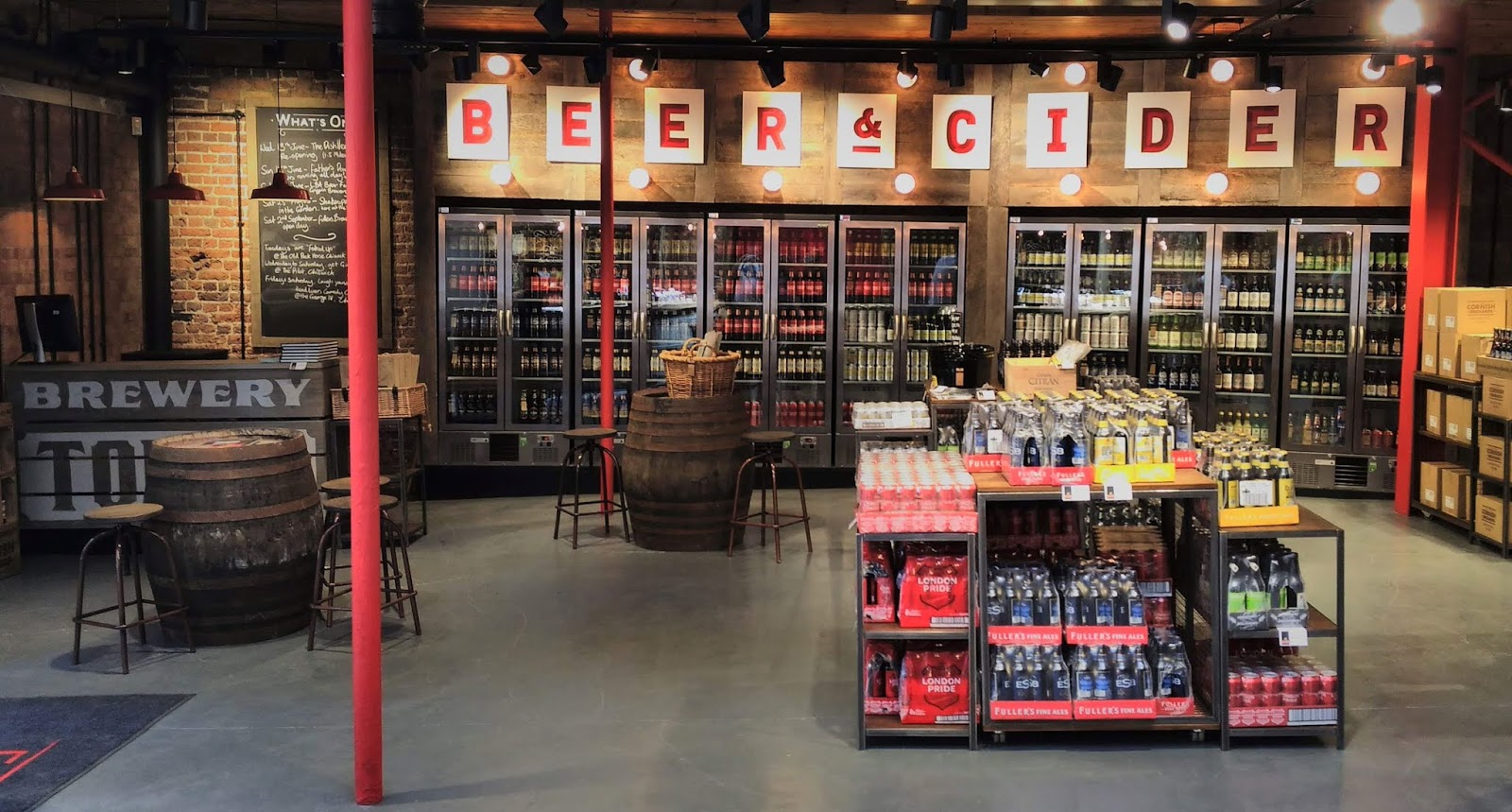
When Fuller's brewery shop closed a few weeks ago for refurbishment, I wondered what it might open as. Would they go full-on craft beer store, with beers from their friends and so on, or would it just be a paint-job and some new furniture? So when I saw on Twitter that it was reopening today, I jumped on my bike to have a look.
It doesn't look that different from the outside at first - it's been a sunny day, so the inside looks a bit gloomy. However, if you peer closely you can make out the first change - it has expanded inside to the right of the main entrance, into the space behind the old door labelled The General Store.

This space is the new wine shop, looking much expanded and also housing both the glassware and souvenirs.

Behind the doors at the back is a space fitted with a boardroom-type large table and a big screen. Its curved wooden walls are to put you in mind of yes, a Tun Room, as it says on the doors, and it is a meeting venue that'll be available for hire.

At the front by the windows, there's a fridge with assorted beer-infused food items, from cheese and sausages to sticky toffee pudding!

Back in the main space, almost the whole of one wall is now bottle and can fridges. The desk at the left (where there's also a blackboard for events listings - key ones to watch out for are the London Brewers Alliance beer festival in the brewery yard on Saturday 23rd June, and the Fuller's brewery open day on Saturday 2nd September) is the meeting point for brewery tours.

In the fridges, it's mainly products from the Fuller's family, so that includes some Dark Star bottles, Cornish Orchards ciders, plus some of the others that Fuller's distributes - that's bottles from Sierra Nevada and Chimay. Being able to sell these all in cooled form will please many, I'm sure.

Opposite that is, to some surprise given that the Mawson's Arms is just a few doors away, is a bar, featuring four handpumps and several keg taps! There's no glasses though, and you can't drink here - it's just for filling growlers. There's even a special machine to flush the growler (which is basically a large screwtop bottle) and if keg, to add a bit of pressure after filling.

Here's Paul, the general manager, demonstrating the filler (right). Apparently the new shop is going to be the centrepiece of Experience the Works, the new Fuller's "visitor experience".

A word on the growlers - these reusable take-away flasks are an idea that's hugely popular in the US, which may be why the Fuller's ones are the somewhat unusual size of a tad over 3.5 pints. Sharp readers will have guessed that's because they are actually half a US gallon. Anyway, an empty growler is £12 and then fills and refills are in the vicinity of £8, depending on the beer.

But it's at the back of the shop, past the bar, that you can see the pièce de résistance: Fuller's long-anticipated pilot brewery, all gleaming steel - and yes, fitters in fluorescent waistcoats, as by the look of it, it's not quite finished yet...
As you might expect, the plan is to use this both for trial brews and for short-run and special release beers - there's already at least one Twitter thread asking for suggestions. I know the brewers are very much looking forward to getting their hands on the new brewkit - and I'm looking forward to getting my hands on the results!

Monday, 21 May 2018

Trebles all round for music-themed Signature

When I first came across Signature Brew, with its music industry-themed beers, I confess I thought it was a gimmick. I assumed it was another of those generic "Rock Pale Ale" type beers, contract-brewed and labelled with the name of a venue or a music promoter. And indeed, it did indeed start out by doing  collaborations with bands I'd never heard of, creating beers that were nomad-brewed at places such as Titanic and London Fields, and which never appeared anywhere I went drinking or beer-shopping.

It wasn't long before I realised my mistake. As time went by, I encountered more and more of their beers on sale – some were even cask-conditioned, glory be!! In the process, I discovered that they were accomplished core brews that were branded for Signature itself, not for a band.

Four regulars, plus 'special guests'
They all still had music-themed names though – it turns out Signature's founders come from the music industry, hence the brewery's tagline (hey, everybody has to have a tagline these days…) of "Brewing with Music."

Then this year, two things happened on the exact same day in March: first, the news came that Signature had won the 2018 Brewery Business of the Year award from the Society of Independent Brewers, and second, I encountered Anthology, their stunning 10% Imperial Stout, on draught at the London Drinker Beer Festival. I realised that this was now a real brewery, with real brewers – and with real ambitions!

So when the brewery's publicity chap got in touch with news that they were launching a 9.4% Triple IPA called Treble, and would I like a sample, I was intrigued. Well, OK, there may have also been elements of "Are bears Catholic?" and "Does the Pope...?"

When the beer arrived, he'd kindly added a few more samples, including one of Anthology. Perhaps to cock a snook at the beery establishment and the neo-Puritans, while the regular Signature Brews are now in 330ml cans, the specials are in 440ml 'extended editions' – yes, almost half a litre of Triple IPA goodness!

And very, very good it was, too. Treble's an almost glowing amber-brown, with a fine head and aromas of pine resin, touches of onion skin and toasted orange, and a hint of mango. At first it's rich and malty-sweet on the palate with dark marmalade notes, then drying resinous hoppiness and alcohol slide in. The bitterness is there, but pretty moderate in context. Lovely! (If you'd like some, it looks like it's still available, despite its 'special guest' status, as there's still check-ins popping up on Untappd.)

He also sent news of the latest band collaboration brew – yes, they're still doing them, this one is a Grapefruit Sour created with London alt-pop outfit Banfi. I love both good sours and grapefruit, but sadly couldn't make it to the launch event.

If you're in London over the coming late May bank holiday weekend though, you can catch up with Signature Brew at Mason & Company in Hackney Wick. There's a Signature tap-takeover all weekend with seven beers on, and on the Friday night there's also a tutored tasting of five beers – that last bit is ticketed and will cost you £11.37 (weird price, but it includes a booking fee). By chance, I noticed that the place currently has that Grapefruit Sour on tap. Hmm...

Tuesday, 20 February 2018

The Bermondsey Beer Mile is flourishing again

A couple of years ago, I came to the conclusion that the Bermondsey Beer Mile had lost its appeal. It had jumped the shark, a victim of its own success. The Kernel had closed its drinking area, and the other brewery taps were often overwhelmed – some, like Partizan, had a bar but little seating space.

What a difference those two years have made. OK, even on a freezing day in February, respected and well known places such as Brew By Numbers and Anspach & Hobday still get busy, and Eebria – one of the newer bars – was so rammed I didn't even bother trying to get served. Apart from that, and despite the many groups of people strolling from venue to venue, it mostly felt comfortable.

Fourpure, now times two
The overall story is expansion – existing breweries moving and growing, new ones moving in, more beer retailers, and so on. At the eastern end, Fourpure has taken over into the industrial unit next door. This has added a lot of production and workspace for them, but has also allowed the taproom to expand, with more seating space and a new bar. They also now have a proper spacious indoor toilet block, which highlights just how shamefully dismal are the loos in pretty much every other local brewery and bar.

Heading west, Partizan’s move to a new and much bigger site, with both indoor and outdoor seating, was long overdue. Being an industrial building, the taproom might be a bit overly echoey and noisy for some, but it has much more space and a bigger bar (right) with guest taps too – when I visited, there were several Kernel beers on.

The move also freed up two railway arches on Almond Road, making room for not one but two new breweries. Well, one isn’t totally new – the highly experimental Affinity Brew Co moved down from Tottenham. And the other, Spartan Brewery, isn’t totally a brewery as it doesn’t yet have its brewkit in (they’re brewing up the road at Ubrew for now).

To make it even better, while the other breweries on the Mile – with the notable exception of Southwark – are keg-focused for their draught beers, both these new ones plan to package a significant proportion in cask. Sadly, neither had cask on when I visited, although Spartan co-founder Colin Brooks said he’d like cask to eventually become the majority of their production, and they’ll have casks at London Drinker Beer Festival next month.

Meanwhile, Affinity (left) is organising a weekend Bermondsey cask beer festival for April 7th-8th. Co-hosted by Partizan, this will feature 30 breweries from up and down the country, each brewery supplying two different casks, one for Saturday and the other for Sunday. Tickets are available online and cost a fiver for each day – that covers a glass, a programme and your first half, then it's a fiver a pint. And no, I don't know if there's a refund on Sunday if you still have your glass from Saturday!

Sunday, 21 January 2018

What really killed Watney's Red Barrel?

Red Barrel reborn
People who remember the Keg Wars of the 1960s still talk of how keg bitters were pasteurised and fizzed-up, knocking much of the character out. Some of the stupider ones also talk of today’s keg craft beer as if it’s treated the same (they’re wrong – much of it would fit CAMRA’s definition of real ale), and a few will also trot out how keg bitter was supposedly brewed cheaply and “full of chemicals”.

Full of chemicals? For the pedant, pretty much everything is a chemical – salt is a chemical, even water – but that’s not what they mean. They mean additives and impurities, things that probably wouldn’t be permitted under food regulations. Again, they’re almost certainly wrong – unless you count “processing aids” such as PVPP*, which is permitted under the Reinheitsgebot for instance.

Yet they might also be sort-of right, in a weird way that they probably wouldn’t recognise, and for something that they would almost certainly not think of as a “chemical” – and that is sugar.

That review in Which?
I didn’t become a beer drinker until a while after the seminal 1972 review of keg beer in Which? magazine – its criticisms helped drive the growth of CAMRA and the rebirth of cask – so I didn’t experience 1960s keg bitter. I’ve read quite a bit though about the likes of Whitbread Trophy, Double Diamond, Worthington E, and of course the legendary Watney’s Red Barrel, including the interesting tale that some of these beers were also available in cask form in small volumes, and were considerably better like that.**

So when I heard that one of my local brewpubs, The Owl and The Pussycat in Northfields, had brewed a cask recreation of 1963 Watney’s Red Barrel to a recipe devised by beer historian Ron Pattinson, I knew I had to try it. Earlier this week, I did just that, and it wasn’t half bad! It was also by far the pub’s bestseller, selling almost an entire firkin on the first night it was available, which will have had a fair bit to do with nostalgia and curiosity.

As I sipped my Red Barrel, a fairly pale amber-brown beer of 4.4% ABV, I detected light malt, a moderate and slightly earthy bitterness, and touches of biscuit and fruit. Yet I also found myself thinking how unlike modern bitters it was, even the keg ones. There’s lots around the same strength, but even the golden ones tend to be fuller-bodied, a little sweeter, a little more flavour-forward.

It was when I spoke to the brewer that I got an inkling of what was going on. He mentioned that the Red Barrel recipe was very different from their other ales in two ways: it contained a significant amount of sugar, and was relatively highly attenuated, meaning more of the sugars were fermented out to leave a drier body.

Re-reading some of Ron’s writing on those 60s beers, it makes sense. The grists of the period – grist is the mixture of malt and other fermentables – were typically 10% to 15% sugar (although he notes that Red Barrel used less than that). The typical reason for adding sugar and other adjuncts (sources of fermentable sugars) is to lighten the body, in a milder easy-drinking, don’t-frighten-the-horses sort of way. It can also improve stability and heads retention – and yes, it can save money (though not always).

So maybe, just maybe, the real reason people found 60s keg bitter insipid wasn’t just the blandifying effects of pasteurisation and fizz – though I’m sure they were (and are) important – but the fact that it started out as a light-bodied and fairly dry brew. In cask, it could just about overcome its limitations, but killed and kegged, well the poor thing didn’t stand a chance.


*PVPP (polyvinyl polypyrrolidone, or Polyclar) is a powdered plastic used as a clarifier. Anti-Reinheitsgebot campaigners say that the rule is simply a marketing tool of the big German brewers – and that it lets them cheat by claiming the PVPP is filtered out after use, so it doesn’t count as an “ingredient”. The German beer purity law also failed to prevent a 2016 scandal when some beers were found to contain traces of glyphosate weedkiller at a level up to 300 times that permitted in drinking water. The beers had been made only with malt, hops, yeast and water of course, but the malt had been made from contaminated barley. 

**Around 20 years ago I sometimes drank a perfectly acceptable cask ale branded as Worthington E, but I'm pretty sure it was nothing like the 60s version!

Thursday, 28 December 2017

Winter beer & food matching

To re-purpose an old joke, beer/food matching events are like buses – none for ages, then three come along at once. Just to confuse things, I’ll write about the first of the triad separately, as the food-matching element there didn’t coalesce that well, so it ended up being secondary to the chance to taste beers from DE15, which is Marston’s new nanobrewery.

Instead, let’s start the following day, with the British Guild of Beer Writers’ annual dinner. A team of four had worked together on curating the menu. One of them told me some of the staff of the hotel where we had the dinner had joined in too, but to learn rather than advise, as they don’t do this kind of thing routinely – indeed, one reason for running these events outside the ‘beer world’ is to evangelise.

Modus Operandi
We began with roasted Arctic cod, served over a fennel-based bedding and paired with 01/31 Saison from Brew By Numbers, which features two New Zealand hops (Motueka and Wai-Iti) and one Australian (Vic Secret), all of which typically contribute notes of tropical fruit and an assortment of citrus. The Saison was delicious on its own and also worked pretty well with the fish, although for me the latter’s almost-vegetal character didn’t quite mesh with the fruitiness of the beer.

The top pairing was the main course: roasted duck breast with roasted salsify, celeriac and orange sauce, matched with Wild Beer’s Modus Operandi, a complex and fascinating sour red ale. This was also the course with a veggie alternative – roasted aubergine and salsify, again with orange and celeriac (among other things!), but partnered instead with Wimbledon Brewery’s Quartermaine IPA.

Of course, everyone simply had to try both beers “just in case”, and yes, the toasty-crisp and malty-bitter Quartermaine could have gone well with either, but didn’t go as well with the duck as the Modus did, while the Modus overpowered the roasted veg. So, great choices there.

Dark Side of the Moo
For a change, dessert was light-coloured, but paired with a dark beer – in this case, apple & rosemary mousse with caramel ice cream, with a bottle of Dark Side of the Moo, a 7% Imperial Porter from Old Dairy Brewery. Roasty-dry and pithy-bitter, with notes of coffee, ashes and strawberry, the latter is almost an Imperial Schwarzbier, and it provided an interesting contrast to the creamy-sweet dessert. A good reminder that when you’re food-matching, a good contrast can be even more complementary than a strong similarity.

The cheeseboard also brought a less traditional pairing – rather than a Barleywine, or perhaps an ESB, they went for a richly-hoppy and fruity-dry American-style IPA, namely Fourpure’s 6.4% Shape Shifter. And it worked well – the earthy hoppiness, with its fruity and onion skin notes, cut through the creaminess of the cheddars and the other cheeses.

Beer rack at Borough Wines Hackney
The third set of matches the following morning was very different. I was one of a small group invited to brunch by Borough Wines & Beers, a company which used to be called simply Borough Wines but has pivoted into beer in a significant way – you’ll now find a small but well curated range in each shop, and it even brews its own beers in the basement of its Hackney shop, on a nano-brewery appropriately called Brewery Below. Also in that basement are a tiny kitchen and Pete’s Dining Room, which is an event space with – rather unusually – an iron grille for a door. It turns out this is not a prison for beer writers, it’s just that this was originally the basement of a bank, and this was the vault.

This time, the menu was all about showing how well a good London-brewed beer can work with spicy food – well, after an introductory beer cocktail. Featuring grapefruit, lemon, elderflower liqueur and Pilsner, this was tasty yet the beeriness was rather low-key. Beer cocktails have been popular in some places for many years, has their time come in London?

Alt & savoury brioche
Anyway, after that it was on to Orbit Neu, a Düsseldorf-style Altbier (yes, there are other Altbier styles) brewed in South London. I’ve enjoyed Neu before but not as it was here, paired with a sweet brioche bun filled with sliced spicy chorizo, a dab of sweet chilli jam, and avocado. And it worked well, the malty sweetness of the Alt complementing and smoothing the spicyness of the food.

Next up was a sort of daal, made with tarka beans and accompanied by Beavertown’s collaboration The You Zoo. The latter is an IPA which at 7.5% verges on the Double, and features two ingredients that have been very fashionable among edgy brewers in recent years – yuzu, which is a citrus fruit, and tea, in this case Formosa Oolong. To my surprise, it was the food that expanded the beer here, with the daal bringing out the beer’s fruity bitterness.

Yuzu IPA & daal
It was fish next – “blue corn smoked haddock arepa” – I had to look up the latter, it’s an unleavened maize bread from South America, so I assume it’s the arepa, not the smoke, that’s blue corn. I also hadn’t realised that blue was one of the many colours that maize comes in, but it is! Anyway, this was served with Hop Chowdah, a 6.9% New England IPA from Mondo in Battersea. Murky and fruity-hoppy with mild peppery and orange notes, this was excellent with the spices.

So yes, IPAs and bitters do indeed go very well with spicy food, which makes it doubly frustrating that most curry houses have such crap beer lists.

Also frustrating though were my own attempts to do beer and food matching over the holidays. I think part of the problem was that I was trying to match to foods I’d not yet tasted, because we hadn’t finished cooking and they were stuff we’d not cooked before. It’s salutary to recall that in both these cases, the ‘curators’ had worked with samples of both the beers and the menus. You can do a lot with guesswork, but you really need a taste to work with. Ah well.

And on that note, I wish all my readers a Happy New Year, full of excellent beer and food. May your bottles never gush and may all your bars be beery ones!
Beery types behind bars

Sunday, 12 November 2017

Waitrose plans a beery splash with Fuller's & Friends

Waitrose is the place to shop tomorrow, or so it seems! The upmarket retailer has snagged itself a bunch of interesting beer exclusives, and Monday 13th November is when they’re due to arrive on the shelves. (edit: maybe wait until later this week before going in - if my local branch is anything to go by, they'll go on the shelves as and when the delivery happens and the staff have time...) It’s not just the Fuller’s & Friends mixed six-pack of collaboration brews, which I’ll write more about in a moment – the others I know of are two more bottled Fuller’s beers, namely the 10.7% Imperial Stout 2017 and Vintage Ale 2017, and an exclusive beer from Thornbridge.

The latter is a Gose made with watermelon juice. Originally brewed by Londoner Josh Smith, it was the winner of the Waitrose-sponsored 2017 Great British Homebrew Challenge, and one of the prizes is this competition is to have your beer brewed commercially by Thornbridge. The beer’s name, Mr Smith Gose To…, references both its brewer and the 1939 Frank Capra film, ‘Mr Smith goes* to Washington’.

By coincidence, I met Thornbridge’s head brew Rob Lovatt, who was one of the Homebrew Challenge judges, at the launch of Fuller’s & Friends – he is also one of the latter. He noted that one of his aims with the 7.1% Fuller’s/Thornbridge brew, a Red Rye Ale named Flora & the Griffin after the two breweries’ mascots, was that it would age well in bottle – all six F&F beers are bottle-conditioned.

Explaining the F&F project, Fuller’s head brewer Georgina Young said that although the idea came from her predecessor John Keeling, who is now brewing director and brand ambassador, a lot of the drive behind F&F came from Fuller’s marketing department and from Waitrose itself – after all, you can’t do something like this if you don’t have an outlet for the results.

Essentially she paired each of her six brewers with another brewery, each pairing discussed what they would brew, where possible they did a pilot batch at the other brewery – these were the beers that appeared in cask at London Craft Beer Festival and a few other places back in the summer – and then they brewed and bottled the full production batches at Fuller’s during the autumn. “My team have really shown their capabilities, working with their partners,” she said, adding with a grin: “I haven’t been involved in brewing any of the beers, I just wielded the big stick!”

She presented the six, and their brewers, more or less in order of ABV, so first up was the 4.8% collaboration with Fourpure, which is also the only lager in the set. Some have already given Galleon dry-hopped lager the new-fangled tag of India Pale Lager, or IPL, but it’s much more about aroma and flavour than bitterness. The brewers were keen to use the new Loral hop; it has floral qualities so they then paired it with the grape character of Nelson Sauvin hops.

I’ve had dry-hopped lagers before so wasn’t expecting a lot, but Galleon – the  beer's name is meant to reference the meeting of old and new on the Thames – really impressed me, especially as I was incredibly lucky to try it cask-conditioned from a handpump, as well as in bottle.

As Georgina explained, “We thought for fun we’d run off a firkin [cask] of each beer. I’m not sure it’s right for all of them…” Well, I don’t know about the latter, because this cask lager was excellent – fresh lemony malt overlaid with spicy-sweet and floral hops, and a mild pleasing bitterness. It’s also quite possibly the first cask beer that kegophiliac brewery Fourpure has ever produced, and it showed just what they are missing by shunning cask.

Georgina introduces the Matariki brewers,
Fuller's Hayley and Marble's JK. 
Next up was what was probably my favourite of the six, albeit just a nose ahead: Matariki, a New Zealand Saison brewed with Manchester’s Marble. Dry-sweet and lightly funky, with notes of golden malt and grapes, it was best on cask which gave it a slightly creaminess, but is still jolly good in bottle. Its name is a nod to the seasonal origins of the style, said Hayley Marlor, the Fuller's half of the collaboration – Matariki is the New Zealand name of a constellation that appears around harvest time.

Rebirth, the 6% collaboration with Bristol’s Moor Beer that takes the original 1971 recipe for Fuller’s ESB and gives it a 21st century twist, was the only one I’d already tried on cask back in the summer. Where that version was lightly resinous and jammy, with herbal bitterness, this one is more toffee and marmalade, with bright hoppiness. "We did tweak the recipe slightly as we had it too dark, but it is the same beer," said Moor’s Justin Hawke, adding that the other difference from the pilot is of course that he brews all his beers unfined.

He added that, coming from the US where Fuller’s ESB is a classic that has spawned an entire beer style, “I had expected it to be 100 years old, and was surprised to find the first brew was only in 1971!” The ESB recipe has been revised since then, bringing the ABV down and eliminating the adjuncts to make it all-malt. Said Justin, “The old recipe has US, Australian, Slovenian and UK hops, so we decided to update it to what it could be if it used fresh hops from those countries today.”

I’ve already mentioned Flora & the Griffin – it’s sweet and faintly tart, with hints of caramelised and spiced nuts – so next up is the 7% New England IPA, a collaboration with Manchester craft beer darlings Cloudwater. NE IPAs are all about thick hop flavours and aromas, rather than bitterness, so as Fuller’s Henry explained, the planning for this was all about how much hops they could get in at every stage of the process: “It was, would we still be able to empty the fermenter if we put in 80 kilos? At every point I’m thinking ‘Will this beer get out of this vessel?’ – and it did!”

A notable oddity is that where NE IPAs are usually cloudy, this one came out clear – “I don’t know what happened there,” said Henry. I checked though, and it was also one of only two beers in the set that weren’t pilot-brewed. The justification was that Cloudwater rarely repeats its beers, but I fear it showed. It’s definitely not a dud – it’s a nice beer, richly hoppy and fruity-crisp – but I suspect it’s not what it could or perhaps should have been.

Also 7% but saved for last as it is both the only dark and the only smoked beer in the set, is Peat Souper, a collaboration with Cumbria’s HardKnott that was designed as a way to make HardKnott’s impressive Rhetoric #4 12% Imperial Stout more accessible by hybridising it with Fuller’s Black Cab and London Porter. And amazingly, it works! If you know the three beers, you can detect them all in there - rich and lightly smoky Rhetoric, chocolatey Black Cab and faintly roasty and vinous like the London Porter.

Hardknott’s Dave Bailey said the biggest problem had been the amount of notoriously pungent peat-smoked malt in the recipe, which Fuller’s staff had worried would taint subsequent brews in the same vessels. They suggested halving the amount, but he stood firm and eventually won – they had to start at 4am as the last brew of the week, but were able to use the peated malt because the brew was timed just before those particular vessels had their six-monthly overhaul and extra-deep clean.

All in all, Fuller's & Friends is an impressive project. The beers demonstrate variety and innovation, yet at the same time they are all about accessibility and drinkability, rather than pushing the extremes. Not every brewery can achieve that, but as Rob Lovatt noted, “I have great respect for Fuller’s. Drinkability is something Fuller’s has down to a tee, and other brewers could learn a lot from that.“

The value for Fuller's – which as Georgina Young says, now "embraces doing collaborations with partners big and small" – seems clear too. Of course, the big thing is the marketing opportunity, and you can certainly see why they're pitching the boxed set as an ideal Christmas gift for the beerily-inclined!

But there's also the 'rising tide that floats all boats' aspects. All the brewers involved seem to have learnt something, whether it's guests who normally brew on something eight or ten times smaller and non-automated, or Fuller's brewers who had never manually dug out a mash-tun before! And just as importantly, they all appear to have had a great time. 


*I’m afraid that when I see attempted puns like this, my first thought is that someone doesn’t know how to pronounce Gose (hint: “Go-ser”). Ah well, never mind – I plan to buy and try the beer anyway! 

Sunday, 6 August 2017

Fuller's & Friends at the Cask Yard

Pic: Fuller's
By all accounts, “The Cask Yard” at this weekend’s London Craft Beer Festival has been a great success. As last year, it’s presented and anchored by Fuller’s but features others too – not just cask ale from Sierra Nevada (Fuller’s distributes SN beer in the UK) but also the likes of Redemption, Thornbridge and Wimbledon.

It’s quite a change from the first LCBF events when there was cask, but nowhere near as prominently. Given the major part real ale plays in London brewing, a big cask presence is entirely fitting – no, entirely necessary!

It’s also been the first public outing for a project I heard about in confidence a few weeks ago – Fuller’s & Friends. Fuller’s brewers have been working with colleagues from around the country on a new set of collaboration brews. So far we’ve seen four of what I’m told will be six beers:

#1 – Flora & The Griffin, a 7.4% rye ale, collaboration with Thornbridge.

#2 – Rebirth, 6% “the original 1971 ESB reborn”, a collaboration with Moor Beer.

#3 – Big Smoke, a 7% smoked Porter with Hardknott.

#4 – Matariki, a 5.5% New Zealand Saison with Marble.

Two more to come, then – possibly during today’s final LCBF session. Sadly, I’ve neither a ticket nor the time to get over there this afternoon, but I’m hoping and expecting that all will also be on draught at this week’s Great British Beer Festival. My information is they will then be bottled and sold as a package.

Edited Addendum: Sadly I didn't see any of them at GBBF, but there's also visits from Cloudwater and Fourpure mentioned now on Fuller's Twitter feed, so I guess they are the 'missing' two that'll make it six.

More usefully, I've now heard from a second source that the six-pack will be sold exclusively through Waitrose. True or false, my Fuller's friends?

Wednesday, 2 August 2017

London, the Beer City

The 2017 London Beer City programme, or festival, or whatever you want to call it, kicks off tomorrow, with events all over the city for the next 10 days.

The anchor events are of course CAMRA's huge Great British Beer Festival from Tues 8th to Sat 12th. As usual this is mainly British real ale, but with the addition of foreign real ale and bottled beers, plus English wines and ciders.

Before that though, there's the London Craft Beer Festival from Fri 4th to Sun 6th in Shoreditch - this is a smaller event but more focused, with 45 breweries, many of them bringing new brews and serving them themselves.

A new thing this year (at least, I think it's new) is the beer embassies. Hosted at various venues around the city they will show off some of the best beers - both modern and trad - from elsewhere, for example the USA, Germany and Scandinavia. There's also a load of collaborative brews and other new beers around, including a competition where each of London's top beer stores collaborated with a local brewer on a brew.

For the full programme pick up a printed copy (as seen here) from one of the venues, or visit the London Beer City website.

Monday, 5 June 2017

Fuller's Unfiltered bid for craft keg

When I first heard about the launch of London Pride Unfiltered at Craft Beer Rising earlier this year, my first thought was, oh-ho, a hazy rebranding for the craft generation. But could Fuller’s make the idea work, or would it be like an embarrassing parent trying to be hip? And was it just a rebrand, or a genuinely new beer?

I had all those questions in mind when I got the chance for a brief chat with Fuller’s head brewer Georgina Young – over a couple of glasses of Pride Unfiltered, naturally!

First, a bit of background – I’ve seen this sort of relaunch several times before, especially in Germany, where the marketeers have done a great job persuading the average Josef that all beer is yellow, fizzy and clear as a bell. The industrial Pils that you see advertised everywhere, in other words.

But for the Craft Bier pioneers a few years ago, this heavily-marketed industrial Pils was the enemy, and the easiest way to state your non-industrial credentials was to make cloudy beer instead. Cue lots of murky unfiltered Pale Ales, IPAs and others.

The German industrial brewers seem to have caught up much faster than the UK ones, with Naturtrüb (unfiltered and cloudy) Kellerbiers and others widely available there for a couple of years now. (Amusingly, many of the German craft brewers have now swung the other way, producing clear as a bell dry-hopped Pilsners and the like.)

The first thing George pointed out was that Pride Unfiltered is hazy, not murky or cloudy. More significantly perhaps, it needs to be reliably hazy – consistency is absolutely essential for a brewer such as Fuller’s.

“It’s really hard to get this level of haze just right,” she said, adding that “The haze is not yeast, it’s protein – quite fine.” She also stressed that while the basic recipe “is pretty much the same” as regular Pride, including Northdown and Challenger aroma hops, there are changes. Most notably that Unfiltered is also dry-hopped with Target.

Not too surprisingly, Unfiltered is very like regular Pride, but is drier and less malty-fruity, although that will in part be due to the lower serving temperature. There’s earthy and spicy hops on the nose, then it’s lightly fruity and dry.

And it seems to be doing well – on a recent visit to a Fuller’s pub which had Pride Unfiltered on tap alongside a couple of guest keg pale ales, the barmaid said it was pretty popular. The notable thing is it’s definitely not aimed at the keg Pride drinker, and indeed the Fuller’s folk say there’s no plans to replace keg with Unfiltered.

George also had some news about the Fuller’s beer range continuing to expand. “We’ll do eight new beers this year, four of them cask, plus Unfiltered of course,” she said. “We also have seasonal cask and keg beers and then monthly specials.”

They’re also increasing the range they distribute from other breweries, with Sierra Nevada the most prominent example. One of Fuller’s sales team noted that “We brought over 14 Sierra Nevada seasonals last year, this year there’s six definites plus maybe two or three more. This year’s list include Otra Vez, Sidecar and Tropical Torpedo.” Yet more reasons to visit the bigger Fuller’s pubs – although I don’t expect to see these in my local.

Tuesday, 14 March 2017

Truman's gets all Kölschy

Tank lager for all to see
The invitation to the launch by Truman’s Brewery of a new ‘tank lager’ didn’t really grab my attention at first. After all, I’m not entirely persuaded that these tank beers are a Good Thing. Brewers claim it keeps the beer fresher, among other things, but there’s a bit of me that sees it as just a dressed-up version of the practice much-derided in the 1960s and 70s where keg beer was tankered to the pub, pumped in via a hose, and served from a large tank in the cellar – although in the modern versions the tank is made a feature of the bar, rather than being hidden away.

What piqued my curiosity was noticing that Truman’s RAW Lager was described as Kölsch-style, meaning it is top or warm-fermented like an ale, before being cold-matured as a Lagerbier*. (It was also described as unfiltered, meaning it’s not a Kölsch but a Wiess/Wieß, an even rarer style that’s made a minor comeback during the current German craft beer revolution – but that’s another story!)

The Kölsch aspect rang bells because it’s far from the only example I’ve come across lately. At the extremes, last year I met some new Irish craft brewers who had a Kölsch-style as the lager-equivalent in their range, usually alongside an Irish Red, a pale ale and the inevitable stout. I even heard of some North American beer-geek bars having four or five different Kölsches on tap at the same time.

Just a few years ago, Kölsch was one of those legendary things: not only was it a lagered ale but it was a Beer from the Old Days (in theory, at least**) that you could pretty much only get in its birthplace of Cologne – bar a few one-offs. I recall the now-defunct West London brewery Grand Union doing one in 2004, for example.

So how come Kölsch-style beers – done properly, I hope! – now seem to be pretty much everywhere? Part of it, especially inside Germany, is the realisation that while the name is protected – it's one of the few that has Europe-wide legal protection, not just protection within Germany like Berliner Weisse – the style is not. Indeed, the real historical Kölsch (as opposed to the modern version) would probably have had close cousins across a wide region. So now for example you can drink Bönnsch from nearby Bonn, a bit further south there's Trilsch from Trier, and most recently Bölsch from a jokey Berlin brewpub.

But it's also the realisation that for an ale brewer, it's a much easier step than going all the way to bottom-fermented lagers. It's also significantly cheaper, as Howling Hops head brewer Tim O’Rourke explained a few months ago while I tasted his cask-conditioned Kölsch-style beer, in both natural and smoked-tea variants. He’s done proper Pilsners too, but they tied up chilled tanks for many weeks while the beer fermented out and then matured. Kölsch could be done in half the time, which is superb when you’re short on space and you need lager to sell, not expensive ingredients locked up in storage for weeks on end.

The big brewers have known this for rather longer. Indeed, there’s been hard-to-confirm tales for many years that some of the major UK lager brands are top-fermented before lagering. One of the few to confirm this is Fuller’s brewing director John Keeling, whose Frontier lager is a top-fermented beer.

Enough about the wider world of Kölsch though: what of Truman’s RAW Lager? Firstly, no, I don’t know why it’s RAW in capitals. But there it was, I’d guess 500 litres of it, in a gleaming copper cylinder hanging above the bar of The Eagle, a newly-reopened (and Truman’s-affiliated) gastropub in Ladbroke Grove, which I hope to write more about later.

This glass is too big for authentic Kölsch!
Truman’s head of marketing Jasper Hossack confirmed the time element: “Our previous lager brews only went to a few selected customers – mostly old Truman's pubs, as it happens, We had to keep a small footprint with them because while ale takes a week [to ferment], lager takes up to a month.” He noted that the brewery is also installing three new 120-barrel fermenting vessels – their brewkit is 40-barrels so they’ll have to brew three times to fill each one, but with the longer overall process for RAW that’s not a problem.

He added that while a brewer can work around faults in an ale, “With lager there’s nothing to hide behind. You have to be so on-it, make sure it’s conditioned properly and so on. The tanker also takes a step out of the process as there’s no filling kegs.”

The first sips of RAW are tasty, refreshing and authentic: lightly hoppy, with dry-grassy and peppery noble hop notes over slightly sweet golden malt. Order a pint though, and further down the glass it changes. It becomes sweeter and yes, there’s a hint of a generic Brit-brewed Eurolager.

I guess this is why in Cologne’s pubs, Kölsch is only ever served in 20cl ‘Stange’ glasses – it needs to be drunk fresh, so as you finish one Stange the waiter quickly replaces it. Maybe Truman’s should consider investing in some branded Stanges lined for third-pint measures – that’s 19cl, so close enough, and it’d make a neat talking point!


*One of the problems with beer terminology is that ale and lager are not opposites – the terms refer to different parts of the brewing process. So you can lager a top-fermented ale, as the Kölsch and Alt brewers do, and I guess you could equally well sell a bottom-fermented beer without lagering it (does anyone ever do this? I’ve a suspicion it’s what at least some of the reinvented Zwickls and Kellerbiers amount to). 

**Modern Kölsch is largely a 20th century creation, developed to compete with Pilsner, Helles and Export lagers – remember here that the Bavarian Einheitsgebot [Law of Sameness] wasn't imposed on Northern Germany until the very early 1900s. Indeed, in the years of devastation following WW2 the Cologne brewers were rebuilding themselves as Pils brewers, before the founders of the Kölsch-Konvention persuaded them of the value of tradition.

Wednesday, 1 March 2017

Beery times in old London town

We’ve a beery few weeks in London right now. Last week was Craft Beer Rising, where I had a great time discussing the state of the industry with various of the excellent brewers there – more about that in what’s planned to be a series of future blog posts.

Then next week is North London CAMRA’s London Drinker Beer Festival, and the week after that is DrinkUp.London’s London Beer Week*. The latter, which runs from Monday 13th ot Sunday 19th March, seems to have split up with Craft Beer Rising – last year CBR was the anchor event for LBW, but this year they’re separate events. Oh, and earlier in February was the trade show Pub17 which I didn’t get to this year, but by all accounts it’s developing more and more of a craft beer flavour.

London Drinker is going to be interesting this year, as for the first time it will feature only London real ales – the last couple of years it’s had a London bar, but at least half the beers were from elsewhere in the country. Now, with almost 100 breweries active in the capital it can showcase the best beer it has to offer, whether in cask, keg, bottle or potentially can. There is even going to be a Champion Beer of London competition.

Meanwhile, London Beer Week has moved this year from Brick Lane’s Old Truman Brewery (where Craft Beer Rising has just taken place) to Hackney’s Oval Space (the venue for last year’s London Craft Beer Festival, but that’s moving to Shoreditch this year). As well as brewery-run events, DrinkUp.London is running its own three-day festival at Oval Space, called the Beer Edit. Confused yet?

I’m looking forward to the Beer Edit, albeit with some guarded scepticism! That’s because there’s no beer list for it yet that I’ve seen, just mentions of some of the “brands” taking part – and so far they’re all big ones from outside London, but then this is a week of beer in London, not necessarily of London.

Sharp’s and Guinness are headlining again, both of them put on a good show last year and look set to repeat that this year. Sharp’s will again have a full range of beers including a couple of specials, plus a beer and food matching experience, while Guinness will once more feature unusual beers from its Open Gate Brewery, which is the former pilot brewery at Dublin’s St James’ Gate now operating as an experimental craft brewpub. Beyond that we’re promised Czech Staropramen (a MolsonCoors brand, like Sharp’s) and Pabst Blue Ribbon, which is an American lager that was for a while ‘ironically cool’.

Some of the other London Beer Week events look both more local and rather excellent. For example, the rickshaw beer tours which take you to three different London breweries or taprooms, with a beer at each. They’re sponsored by Jameson’s, which is promoting its whiskey aged in stout barrels (if I remember rightly, this is Franciscan Well Shandon Stout – the brewery then takes Jameson whiskey barrels and ages beer in them!), so they’re only £10 per person.

There’s also a Courage-themed walking tour which visits both the site of the legendary brewery near Tower Bridge, and the new Southwark Brewery which is producing special Courage SE1 cask ales. And there’s a bunch of bars doing LBW specials such as beer cocktails – see the Beer Week website for details.

All in all it’s a great time for beer in London, as befits what was once – and may yet be again – the greatest brewing city in the world. Have fun!


*not to be confused with London Beer City week in August, which is when London Craft Beer Festival and the Great British Beer Festival take place.